How bank money and gold meet at CME
Full saved reading
View cited sources (22)
These are the sources cited by this reading. Each source keeps its own date and scope.
- 2025 CME/Google release
- March 2026 offering
- CME filing, PDF pp. 1–11
- CFTC docket
- Full deck, slide 80
- Current joint NYMEX/COMEX Chapter 7, Rule 705
- Current CME eligibility
- FAQ, pp. 1–2
- Information sheet, p. 1
- Executed agreement, signature and integrated party list
- CME Chapter 8, Rules 817 and 819–820
- GCUL overview
- Service terms, section 56
- Account reference, SettlementMode
- Google/Crypto Finance account
- Client implementation guidelines, execution and error handling
- CME financial-statement note, September 30, 2026
- CME Collateral Custodians and Settlement Banks
- Original filing, pp. 2–3
- Implementation advisory 21-153
- Current CME transaction timelines
- Interest programme FAQ
Saved research reading. Its original dates and claim limits control; the export date does not refresh the evidence.
Saved source details
---
title: How bank money and gold meet at CME
research_id: wholesale-metals
artifact_role: answer
status: current
evidence_cutoff: 2026-11-25
timezone: America/New_York
---
How bank money and gold meet at CME
For the consolidated roles, process paths, source clocks and future-chat restart route, start with the CME BMO Google and gold context map. This report remains the factual owner for that map.
CME is developing a way to move cash-backed margin value on a permissioned ledger alongside an existing system that already accepts gold warrants as collateral. BMO is connected to both investigations: it is the announced first bank for the GCUL cash project, and BMO Bank, N.A. is a signed lender in CME's secured-credit facility. The public record does not yet connect a gold-backed advance to a particular BMO/GCUL token transaction.
This November 25, 2026 source-depth extension belongs to the existing Wholesale Metals owner. It follows the November 24 metals return, September BMO claim/control study, October production return, gold-warrant document investigation and November 24 bank reading. Those records supply the continuing questions; this pass does not refresh their entire regional or bank coverage.
The material advance is deeper public evidence, rather than a newly announced launch. The complete public version of CME filing 26-546 and BMO's March 26 Investor Day deck were recovered. The filing describes its general cash-account architecture, reserve-investment restriction and bank exposures in more detail than the earlier summaries. Slide 80's backing-account statement, previously a search-extracted lead, was directly extracted and visually checked. The CFTC docket remains at 60-day review in this bounded November 25 check.
1. Recover the actual sequence
| Native date | Actor and event | What it establishes |
|---|---|---|
| March 25, 2025 | CME and Google report completing the first GCUL integration/testing phase | Platform testing, with further participant testing and an intention to launch services in 2026. |
| March 24, 2026 | BMO, CME and Google announce the bank-anchored cash offering | Dollar conversion and institutional margin/settlement ambitions; H2 2026 target pending approval. |
| March 26, 2026 | BMO Investor Day, slide 80 | FMI-oriented design and backing-account language; not proof of opened accounts or production. |
| April 22, 2026 | CME secured-credit facility Amendment No. 11 is executed | Existing lending, security and gold-warrant machinery; BMO Bank, N.A. signs as a bank. |
| August 20; September 14 and 18; November 4, 2026 | Internal CME committees and board approve the specified policy amendments/advance notice | Governance decisions recited in the subsequent filing; not the end of regulatory review. |
| November 12, 2026 | Chicago Mercantile Exchange Inc. files 26-546 under Rule 40.10(a) | A proposed tokenized-collateral framework with implementation following required review. |
| November 25, 2026 | Research retrieval and docket check | Better source access and a still-displayed 60-day-review status. This is not a launch date. |
2025 CME/Google release · March 2026 offering · CME filing, PDF pp. 1–11 · CFTC docket
The public filing has 18 PDF pages: its cover, ten narrative pages and seven redacted exhibit placeholders. The actual amendments to seven internal policies are confidential; the public narrative supplies their described mechanics. CME says it will notify the marketplace before accepting a tokenized collateral type. That notice is a useful next evidence gate.
2. The cash-account architecture is now more specific
The amended Counterparty Exposure Methodology is described on PDF page 5, printed page 4. It distinguishes three arrangements:
| Arrangement in the filing | Described underlying relationship | Consequence |
|---|---|---|
| Tokenized cash | Clearing member deposits cash into an account in CME's name at a bank; the bank distributes tokens to the member for performance-bond requirements | CME monitors this as part of its exposure to that cash depository. |
| Tokenized deposits | Traditional deposits moved within a bank through DLT | These join traditional cash and tokenized cash in the depository exposure calculation. |
| Deposit tokens | Tokens represent a direct unsecured liability of the issuing bank | Issuer exposure is monitored; a member cannot post its own or an affiliate's deposit tokens. |
The proposed Investment Policy says tokenized-cash reserves are not eligible for investment. The proposed framework aggregates traditional and tokenized balances against the relevant bank limits. Changing the representation therefore does not make the bank exposure disappear.
This materially narrows the earlier open question about account architecture. There is now a public description of a CME-named bank account for the generic tokenized-cash arrangement. It does not name BMO, Google, GCUL or gold, and does not establish the exact BMO product's selected accounts, issuer, customer claim or variation-payment acceptance. A general policy architecture and a particular deployed instrument remain distinct.
BMO's directly verified backing-account statement
Investor Day slide 80 says: “Backed by cash in FMI’s account(s) at BMO and at the Federal Reserve.” The same slide depicts financial-institution clients, BMO, Google Cloud and an FMI, with intended continuous margin and settlement functions. Full deck, slide 80 · Verified slide excerpt
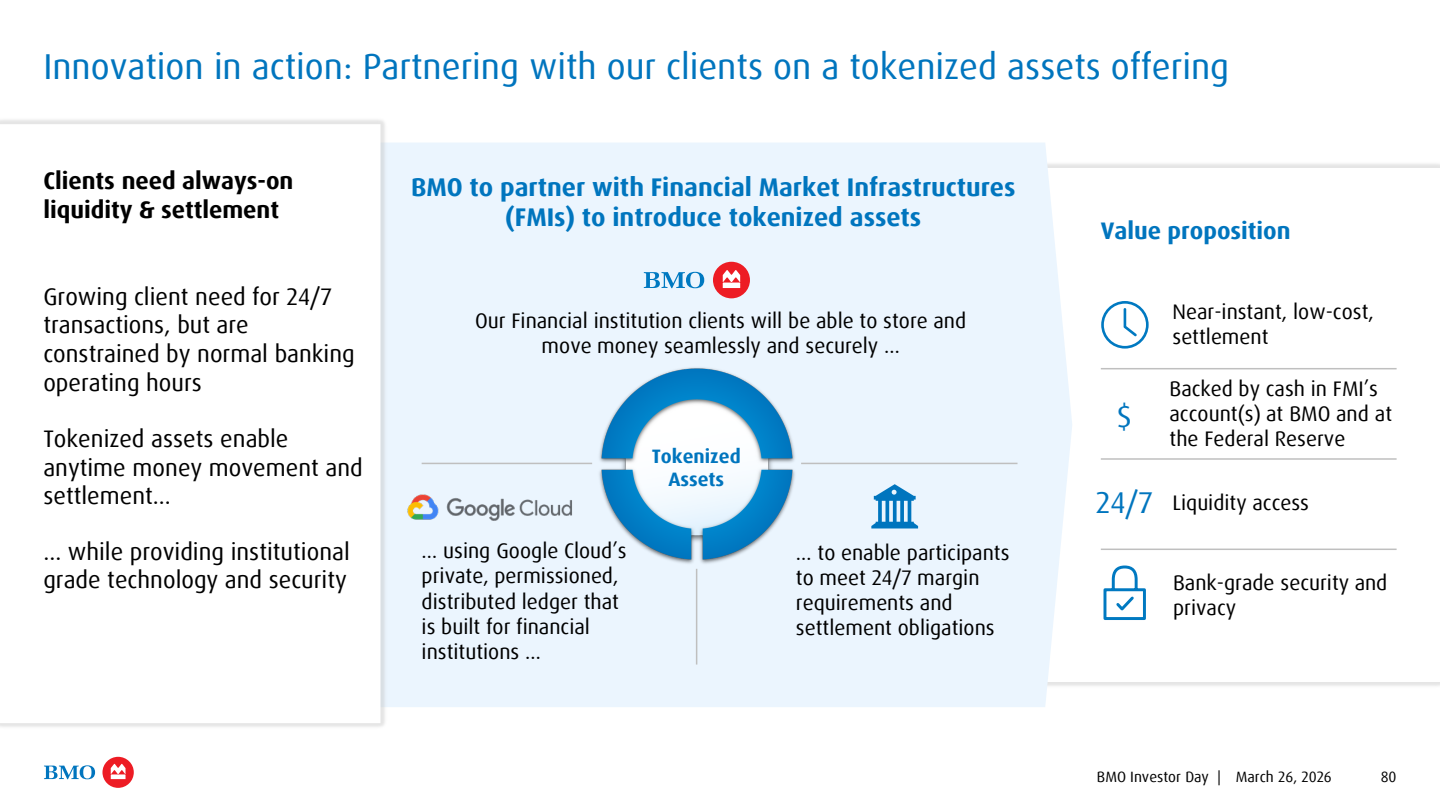
That is stronger than the prior unrecovered search snippet. It remains a management description of the FMI offering. The slide does not identify account numbers, a Reserve Bank, a completed transfer, reserve allocation, customer redemption rights or an executed CME-specific account agreement. It does not give the token holder an established direct claim on the Federal Reserve.
Read together, the slide and filing make a cash-account-based model plausible and more concrete. They do not establish that a gold bar backs the cash token. A gold warrant's collateral value and the cash backing a token are separate assets, claims and records.
3. The gold side already has operative machinery
A COMEX gold warrant is already an electronic document of title linked to specified metal. Its legal character precedes this DLT project. Chapter 7 Rule 705 requires an exchange-approved form, governs issuance/cancellation and prevents duplicate warrants. A warrant pledged at CME cannot simultaneously satisfy a delivery obligation; cancellation requires its release. Current joint NYMEX/COMEX Chapter 7, Rule 705
The current collateral page applies a 15% haircut to accepted gold warrants/London bullion and a $1.25 billion combined clearing-member/affiliate cap. Gold warrants support USD-denominated performance bonds; London bullion is limited to house requirements. Thus $10 million of otherwise eligible gold-warrant market value supplies $8.5 million of collateral value before other constraints. It does not automatically produce an $8.5 million cash deposit or loan. Current CME eligibility
The published FAQ and information sheet describe a pledge initiated in CME's collateral system, communicated to Deliveries Plus, and confirmed there before the collateral deposit is finalized. The older FAQ uses BAMS; the information sheet uses Clearing 21. The FAQ describes pledge-pending and pledged statuses, release of the same warrant and origin-based segregation. Its printed same-day initiation deadline is 2 p.m. Eastern. These are the reached published operating descriptions, not a newly verified 24/7 warrant service. FAQ, pp. 1–2 · Information sheet, p. 1
This makes the tokenization question more exact: would a DLT record become the operative title/control record, synchronize with Deliveries Plus, or represent a separate claim? The reviewed sources do not choose one for a COMEX gold token. The answer determines how a pledge blocks inconsistent delivery, cancellation or another transfer.
4. BMO is already part of the financing structure—but its role must be named
The SEC-filed April 22, 2026 Amendment No. 11 and integrated credit agreement names Chicago Mercantile Exchange Inc. as borrower, Bank of America as administrative agent and Citibank as collateral/monitoring agent. BMO Bank, N.A. signs as a bank, and is included among the syndication/arranger parties. Executed agreement, signature and integrated party list
The agreement expressly addresses gold warrants, underlying gold, related control/security documents and customer gold-warrant advance accounts. Sections 2.9, 3.1 and 5.2(g) cover collateral/proceeds, funding requests and perfection/document conditions. The funding request specifies an advance date that must be a Business Day; that definition excludes weekends, with further agent/custodian conditions for valuations. This is a meaningful funding-calendar constraint to compare with continuous ledger transfers.
The actual connection is institutional and contractual: the BMO group participates in an existing facility whose collateral provisions include gold. It does not follow that BMO Bank, N.A. is the new token issuer, that any facility advance has funded GCUL, or that the loan commitments have been extended to weekends. Facility-specific borrowing-base and advance-rate terms also must not be substituted with the ordinary 15% margin haircut.
Rules 817 and 819 provide the complementary legal structure: CME may use eligible collateral for liquidity under the specified rules, with account-origin restrictions, lender liens and power-of-attorney provisions; CME also has its own security interest. A warrant can support clearing and secured liquidity while the metal remains vaulted. That is the established gold-to-cash route to which a future cash-transfer service could connect. CME Chapter 8, Rules 817 and 819–820
5. Three possible connections, with different evidence states
flowchart TB
  subgraph Existing[Existing gold collateral route]
    G[Gold in an approved depository] --> W[Electronic COMEX warrant]
    W --> P[Pledge and CME margin credit]
    P --> L[Secured liquidity under applicable rules and agreements]
  end
  subgraph Proposed[Proposed generic tokenized-cash route]
    C[Cash deposited in a CME-named bank account] --> T[Bank distributes cash tokens]
    T --> M[Token used for performance-bond requirements]
  end
  L -. Funding a GCUL cash transaction is not established .-> C
A. Conventional gold collateral alongside tokenized dollars. A member posts a warrant for eligible margin requirements and separately obtains tokenized cash for another admitted obligation. This does not require putting gold title onto GCUL. It could improve cash movement while gold custody stays in its established system. The gold route exists; the precise BMO token service and its accepted uses still need their own effective terms and operating evidence.
B. Gold-secured financing supplies cash that is then tokenized. A lender advances dollars against permitted gold collateral; those dollars enter the admitted cash-token arrangement. This would join the financing and payment functions. It needs an actual loan, correct borrower/account, available lender funding, cash deposit and token issuance. It is a conditional path; the public record reviewed does not trace that joined transaction. The loan creates a repayment obligation and encumbrance, rather than free liquidity from token issuance.
C. A tokenized gold claim itself is posted. A digital gold warrant or another gold interest could enter CME's new framework only after the specific instrument, legal rights, network, custody and conversion mechanism pass review. Gold's existing eligibility supplies a relevant starting point, but no reviewed CME source names an accepted tokenized COMEX warrant or GCUL gold deployment. London PGI remains its separately documented pilot.
In cases B and C, a faster record transfer must preserve control over the underlying claim. Two platforms showing balances are not proof that the same warrant can safely support two simultaneous dispositions. Atomically transferring two on-ledger records would need a prior legal and operational bridge to those rights.
6. What Google provides, and who still governs the money
GCUL's documentation separates platform, currency, token, account-manager and settlement roles. Google's service terms say the currency operator establishes its domain rulebook and controls domain roles; Google can act on operator instructions. Google is not a party to that rulebook and does not adjudicate participants' monetary-value or settlement disputes. Those responsibilities belong in the participant and product agreements. GCUL overview · Service terms, section 56
The current Account reference exposes two settlement modes. Deferred: a settlement role tracks off-ledger funds and periodically synchronizes balances. Instant: a single fund pool is allocated between token managers by the ledger. The selected BMO/CME mode was not identified. Account reference, SettlementMode
A useful concrete comparison is Google's October 26, 2026 Crypto Finance Swiss-franc pilot account. It says that pilot chose deferred settlement: customers transferred balances instantly while participating banks settled periodically off-ledger. The currency operator maintained the rulebook and a registry recording settlement at a threshold. Some backend actions remained manual. Banks used GCUL behind their familiar customer interfaces. These are co-authored provider descriptions of a pilot, not independently measured commercial production or a BMO configuration. Google/Crypto Finance account
The same article proposes a future use of segregated digital collateral to raise issuance limits, mentioning AnchorNote. That is a relevant design possibility for understanding how collateral and payment capacity could interact. It does not identify gold, CME adoption or a completed collateralized issuance. Its assertions about virtually eliminating risk are not adopted here as tested results.
GCUL also supports all-or-nothing transaction chains. Its client guidelines distinguish finalization from a successful outcome: the returned certificate contains an OK or failed execution status. Applications must inspect that status and handle remediation. These mechanics improve the description of reliable record processing; they do not prove legal discharge of a particular obligation. Client implementation guidelines, execution and error handling
For CME, Rule 814 separately governs settlement-variation payment and finality. It requires cash or another approved payment form and specifies bank-account finality. The public description of a token for performance bonds does not alone identify approval of that token for variation payments. CME Rule 814
7. The gates that make the gold connection concrete
The full filing gives more specific tests than a generic launch watch:
- Rights and conversion: the specific token must provide equivalent legal/economic rights, with initial and recurring conversion testing where applicable. Assess time to reach the traditional underlying asset and then available liquidity.
- Asset, token and network approval: CME's Credit & Liquidity Committee evaluates each; information-security approval applies to the DLT. The framework does not automatically approve every digital version of eligible collateral.
- Custody and segregation: hosted key custody must meet the described U.S. bank/trust criteria; alternatively CME holds keys with an approved wallet provider. Customer, swaps-customer and house origins retain separate wallets.
- Counterparty and concentration limits: noncash token limits and bank exposures remain meaningful. The aggregate noncash-token limit is to be disclosed before acceptance. Deposit-token self/affiliate posting is excluded.
- Actual acceptance: member agreements and a marketplace notice precede acceptance. Tokenized government MMFs have their own committed-liquidity prerequisite; that condition must not be generalized into a disclosed gold-token commitment.
Source: 26-546, PDF pp. 3–10. These are proposed controls described in the public narrative, not proof of effective implementation or independently tested performance.
A worked funding distinction
Assume a member has $10 million of eligible gold warrants. The 15% margin haircut gives $8.5 million of collateral value. If a separate $2 million variation payment comes due, the margin credit is not automatically $2 million of spendable cash.
The member or the relevant liquidity mechanism must supply that cash under its terms. If an admitted cash token can pay the exact obligation and be reused by the recipient, a transfer might avoid an immediate external bank payout. If the recipient needs external dollars, redemption and payment-rail availability still matter. If a gold-backed loan must first be drawn, the lender's funding calendar matters. The same original warrant cannot be assumed to remain freely transferable after it has been pledged.
This illustration changes no source claim about actual positions, a particular lender's advance rate, selected GCUL mode, accepted payment form or completed transaction. It identifies the point at which faster infrastructure can improve liquidity use and the point at which new funding or legal permission is still required.
What changed in the understanding
The earlier answer correctly separated token movement, collateral and settlement, but left the generic backing account as an open object. This pass supplies CME's public CME-named-account definition and a directly verified BMO slide. It also names BMO Bank, N.A.'s existing credit-facility role. Those are substantive connections, even with the deployment and joined-transaction questions still open.
Analytical reading: this looks like an attempt to make existing institutional claims usable across more hours and systems while retaining bank counterparties, clearing governance, custody, collateral limits and lending arrangements. The gold connection can be economically important without a gold-redeemable cash token: gold can support risk capacity or a loan, while a separate dollar instrument handles an admitted payment or collateral movement. Successful modernization remains a plausible account of this development.
The decisive next evidence is a named cash-token acceptance notice and terms, followed by a transaction linking an admitted gold pledge or advance to cash-token funding/use. Alternatively, a named digital gold instrument, its operative title/control bridge and CME acceptance would establish the separate gold-token route. No such joined operating record was located in this bounded review.
Custody, filing and limits
The selected evidence ledger records source versions, page locators, hashes of temporary PDFs, the checked slide excerpt, native dates and boundaries. The complete 18-page public filing was read, including its seven redacted placeholders. The 178-page Investor Day deck was searched throughout and relevant pages 79–80 inspected; no claim of reading every business slide. Current rulebooks were inspected at the cited provisions; the entire credit agreement was not reread clause by clause. No private agreement, actual reserve account or participant account was accessed.
Disposition: dated source-depth extension under wholesale-metals; source-backed joins to existing BMO/CME, gold-collateral and tokenized-collateral-stress threads. No authored story is created for this research date. The bank-goal and crypto-map owners retain their own clocks. Existing graphics, astrology, Q, schedules, installed app and public publication are unchanged. No contact or information request was sent.
Continued investigation — cash custody, title control and interest
November 25, 2026, second wave. The next pass followed the identified bank accounts, lender accounts and depository confirmation rather than repeating general launch searches. It adds the reported Federal Reserve cash balance, BMO's approved settlement role, current transaction cutoffs and the historical customer-gold control gate. None is a newly verified GCUL deployment.
CME already has a large central-bank cash account
CME's September 30, 2026 financial-statement note reports $139.1 billion in its cash account at the Federal Reserve Bank of Chicago, included in performance bonds and guaranty-fund contributions. The note attributes account authorization to CME's systemic-FMU designation. This supplies the named central-bank location that BMO's more general slide did not identify, but it does not establish that BMO's planned offering uses that account or earmark any of the balance as token reserves. CME financial-statement note, September 30, 2026
The distinction matters: a proposed tokenized-cash service can draw on an institution's existing account infrastructure without giving token holders central-bank accounts of their own. The reported balance is collateral-system cash at a particular date, not a measure of token supply, BMO deposits or gold backing.
BMO's approved functions are more specific than the brand relationship
The current CME bank-role page was inspected with its visible Base Guaranty Fund and IRS tables. The checkmarks are lost in ordinary web text extraction, so this pass read the displayed tables and their actual cell/checkmark associations.
| BMO Bank, N.A. role on the inspected page | What the table marks | Limit |
|---|---|---|
| Base-product settlement bank | All 13 displayed Base currencies, including USD, marked | Approval to perform settlement-cycle functions, not a transaction receipt. |
| IRS settlement bank | All 18 displayed IRS currencies, including USD, marked | Separate product table; no new token instrument identified. |
| Base and IRS collateral custodian | U.S. Treasuries/U.S. Agencies and IBRD marked | Other collateral columns must not be inferred from this membership. |
| Gold / gold-warrant custodian | BMO's cells are unmarked in both inspected custody tables | A fact about these rosters, not a claim about every BMO metals business. |
CME Collateral Custodians and Settlement Banks
Together with the executed facility, this documents BMO in the established settlement and financing network. Depositories, title control, lender security and a possible cash-token issuer still require their own role assignments. The roster's publication date is unspecified; November 25 is the inspection date, not a newly inferred approval date.
Gold margin credit requires depository confirmation
CME's March 3, 2021 submission 21-119 says customer-origin warrant collateral passes through to CME, remains subject to customer segregation, and receives performance-bond credit only after the depository confirms that the warrant transferred to CME on the depository's books. This was described as securing UCC control. The subsequent April 29 advisory records implementation effective April 28, 2021, including Clearing 21/Deliveries Plus enhancements and origin-based accounting. Original filing, pp. 2–3 · Implementation advisory 21-153
That is a concrete gate for any future token bridge: an on-ledger instruction would need to cause, incorporate or synchronize the depository's legally sufficient control confirmation. Merely displaying a warrant token beside a cash token does not establish the completed collateral deposit.
The filing also explains the original 15% haircut using gold-price volatility, a two-day liquidation period and an additional qualitative cost buffer. This is a historical calibration rationale. The current 15% rate was separately checked in the earlier wave; the filing's old $750 million limit is not today's $1.25 billion cap. Faster technical transfer could affect some operating delays, but does not by itself establish a new liquidation horizon or zero market risk.
The live Banking Timeline independently retains a 1 p.m. Central cutoff for gold-warrant deposit/withdrawal requests for margin credit, 2 p.m. for general noncash collateral requests, and 2:30 p.m. for USD cash requests/receipt in CME settlement-bank accounts, subject to its stated exceptions. These are current posted ordinary processing cutoffs, not a new GCUL schedule. Current CME transaction timelines
A customer-gold advance has a controlled-account path
The April 2026 integrated credit agreement's section 3.1 specifies a USD-only customer-gold-warrant advance route. It directs the proceeds to designated customer-gold-warrant advance deposit accounts and includes those proceeds in the collateral-pool calculation. Its monitoring agent evaluates both the collateral pool/borrowing base and the specified customer warrants' discounted value. Section 5.2(h) and (m) adds applicable control-agreement and customer-gold authorization/consent conditions. The same agreement's section 12.1(a) excludes designated customer-segregated-fund accounts from its general setoff clause. Executed agreement, sections 3.1, 5.2 and 12.1
These provisions are more specific than an unrestricted loan paid to a member's ordinary checking account. They also prevent treating all gold, cash proceeds and customer assets as one freely reusable balance. The incorporated Security and Pledge Agreement and particular control documents remain necessary to resolve the complete account, lien and release structure. This reading does not establish a draw, its funded amount or token use.
Interest is part of the economics that the token terms must settle
CME's September financial note reports third-quarter cash performance-bond/guaranty-fund earnings of $1,391.7 million and related interest-distribution expense of $1,269.0 million. Their arithmetic difference is $122.7 million, before other costs and taxes. These are portfolio-level reported amounts, not GCUL revenue or earnings solely on the Chicago Fed deposit.
The published Cash Interest Pass-Through FAQ, dated March 20, 2025, uses daily trial-balance amounts, calculates interest daily and pays monthly. It returns interest to the originating account classification, including customer-segregated accounts; member-directed IEF2 investments have separate treatment. Financial-statement note · Interest programme FAQ
The proposed restriction on investing tokenized-cash reserves does not, by itself, settle whether a backing deposit earns interest or who receives it. Ordinary collateral interest terms do not automatically govern the new instrument. The particular token and bank agreements need to specify interest accrual, allocation, fees and what happens to those amounts on transfer/redemption. No current token yield, spread or client cost is inferred here.
What this wave changes
The proposed cash service now sits beside a documented Chicago Fed cash account, an approved BMO settlement role, a depository-controlled gold-credit gate and a contractually constrained customer-gold funding route. This makes institutional integration a stronger reading than a free-standing gold-token project. It does not complete the missing BMO/GCUL transaction trace.
The next useful source is the actual participant/bank/token agreement or acceptance notice identifying which account receives backing cash, which record extinguishes the obligation, how depository control is synchronized if gold is involved, and whether reserves or proceeds can earn interest or be reused. Targeted official-site agreement searches did not expose those particular terms in this pass; the signed facility's incorporated security documents still were not recovered as complete public instruments. No records request was sent.