CME BMO Google and gold collateral context map
Full saved reading
View cited sources (7)
These are the sources cited by this reading. Each source keeps its own date and scope.
Saved research reading. Its original dates and claim limits control; the export date does not refresh the evidence.
Saved source details
---
title: CME BMO Google and gold collateral context map
research_ids: [wholesale-metals, major-bank-digital-transition]
artifact_role: router
status: current
assembled: 2026-11-25
evidence_basis: source-specific records reviewed through 2026-11-25
---
CME BMO Google and gold collateral context map
CME is developing bank-account-backed tokenized cash alongside an existing gold-warrant collateral and secured-liquidity system. BMO participates in the announced cash project and in CME's established settlement/lending network. Google supplies ledger infrastructure. A transaction joining gold-backed funding to the BMO/GCUL service has not been established in the reviewed public record.
This is the stable entrance for picking up that investigation. The detailed November 25 research owns the substantive findings; the evidence ledger owns source identities, versions, locators and selected inputs. The structured companion records the same relationships as typed links to those sources. This navigation map introduces no new factual owner and no new evidence date for older records.
Pick up the investigation
1. Read the short answer above and the three paths below. Then read the detailed research and its continued cash-custody section.
2. Open the evidence ledger entries relevant to the question. A September balance, a March announcement, a November filing and a source-access date have different meanings.
3. Run Library lookup using the subject words, for example CME BMO Google gold collateral, then resolve the current factual threads through the live Library Spine. The core thread IDs and restart command are at the end.
4. Compare new evidence against the exact open question it answers. Update the maintained research first, then this map and affected navigation. Preserve dated source states.
No new external research was performed to assemble this map. Its starting state is the November 25 investigation. In a later chat, check the date and any newer owner extensions before describing a proposal, balance, roster or pilot as current.
The institutions and their separate roles
| Institution or participant | Established role in this investigation | What remains separate |
|---|---|---|
| CME Group Inc. | Parent and announcement/investor-reporting organization | The holding company, its exchanges and the clearing legal entities are distinct. |
| Chicago Mercantile Exchange Inc., acting as CME Clearing | Registered derivatives clearing organization; collateral, performance bonds, settlement rules and borrower under the secured facility | CME Securities Clearing Inc. is the separate Treasury-clearing project. |
| Commodity Exchange, Inc. or COMEX | Contract market and gold-warrant/delivery framework | Listing a futures contract does not identify a cash-token issuer. |
| New York Mercantile Exchange, Inc. or NYMEX | Related exchange and joint metals-delivery rules; platinum/palladium venue | Product scope and eligibility stay contract-specific. |
| BMO Financial Group | Brand-level participant in the announced BMO/CME/Google offering | The exact issuing legal entity/branch for the proposed token remains unestablished. |
| BMO Bank, N.A. | Signed lender in the April 2026 facility; marked settlement bank in the inspected Base/IRS tables; specified securities-custody marks | Its gold/warrant custody cells are unmarked on those tables. These roles do not establish the token issuer or all BMO metals activities. |
| Bank of America, N.A. | Administrative agent under the signed credit agreement | This is a lending-facility role, not an assignment as GCUL currency operator. |
| Citibank, N.A. | Collateral agent and collateral-monitoring agent under that agreement | Its monitoring and control documents are distinct from Google's ledger roles. |
| Federal Reserve Bank of Chicago | Named location of CME's reported central-bank cash account | No reported amount is identified as GCUL reserves; token holders are not shown to have direct Fed claims. |
| Google Cloud | GCUL infrastructure and API/service terms | Google does not adjudicate the participants' monetary-value or settlement disputes under their domain rulebook. |
| Clearing member and customer | Posts collateral, carries obligations and designates account origin | House, customer-segregated and cleared-swaps-customer assets are not one unrestricted balance. |
| Approved depository | Holds physical metal and confirms warrant transfer/control in the established process | Depository approval, collateral-custodian status and digital-key custody are distinct permissions. |
| CFTC | Supervisory/filing authority for the reviewed clearing proposal | A filing or review status is not an effective specific-token acceptance or a production transaction. |
For the source basis, see evidence IDs cme-26-546, cme-credit-agreement, cash-financial-note, bmo-bank-role-matrix, metals-chapter7 and gcul-terms in the evidence ledger.
The three paths
Existing gold collateral and liquidity
flowchart TB
  A[Physical gold at approved depository] --> B[Electronic COMEX warrant]
  B --> C[Clearing member initiates pledge]
  C --> D[Depository confirms transfer on its books]
  D --> E[CME receives control and credits eligible margin value]
  E --> F[Warrant remains pledged and subject to release restrictions]
  E -->|Only under applicable rules and facility conditions| G[Secured liquidity and designated cash accounts]
The warrant is already an electronic document of title. DLT would therefore change a record/control or transfer arrangement, rather than introduce the first electronic representation of the gold. The customer-origin filing specifies depository-book confirmation before performance-bond credit; the subsequent advisory records implementation on April 28, 2021.
The current reviewed collateral schedule gives eligible gold warrants a 15% haircut and a $1.25 billion combined member/affiliate gold limit. The eligible uses are USD Base/IRS performance bonds, not simply positions in gold futures. A warrant on deposit cannot simultaneously satisfy delivery; release/control requirements remain consequential.
The signed facility includes customer-gold-warrant advance deposit accounts, valuation, control-document and authorization requirements. The ordinary collateral haircut is not substituted for the facility's own advance-rate/borrowing-base terms. An agreement permitting advances is not proof of a draw.
Read: gold legal/document study, 21-119 filing, implementation advisory, current eligibility, executed facility.
Proposed generic cash-token arrangement
flowchart LR
  A[Clearing member cash] --> B[Account in CME name at a bank]
  B --> C[Bank distributes cash tokens]
  C --> D[Member uses tokens for performance-bond requirements]
This is the general architecture described in CME 26-546, filed November 12, 2026. The proposed policy aggregates relevant cash exposure at the bank and makes tokenized-cash reserves ineligible for investment. It distinguishes this arrangement from tokenized intra-bank deposits and unsecured deposit tokens.
The filing names neither BMO, Google, GCUL nor a gold token. It supplies a relevant generic framework without selecting the announced BMO instrument's legal issuer, accounts, holder claim, deployed mode or accepted variation-payment use. The reviewed CFTC docket still displayed 60 Day Review on November 25.
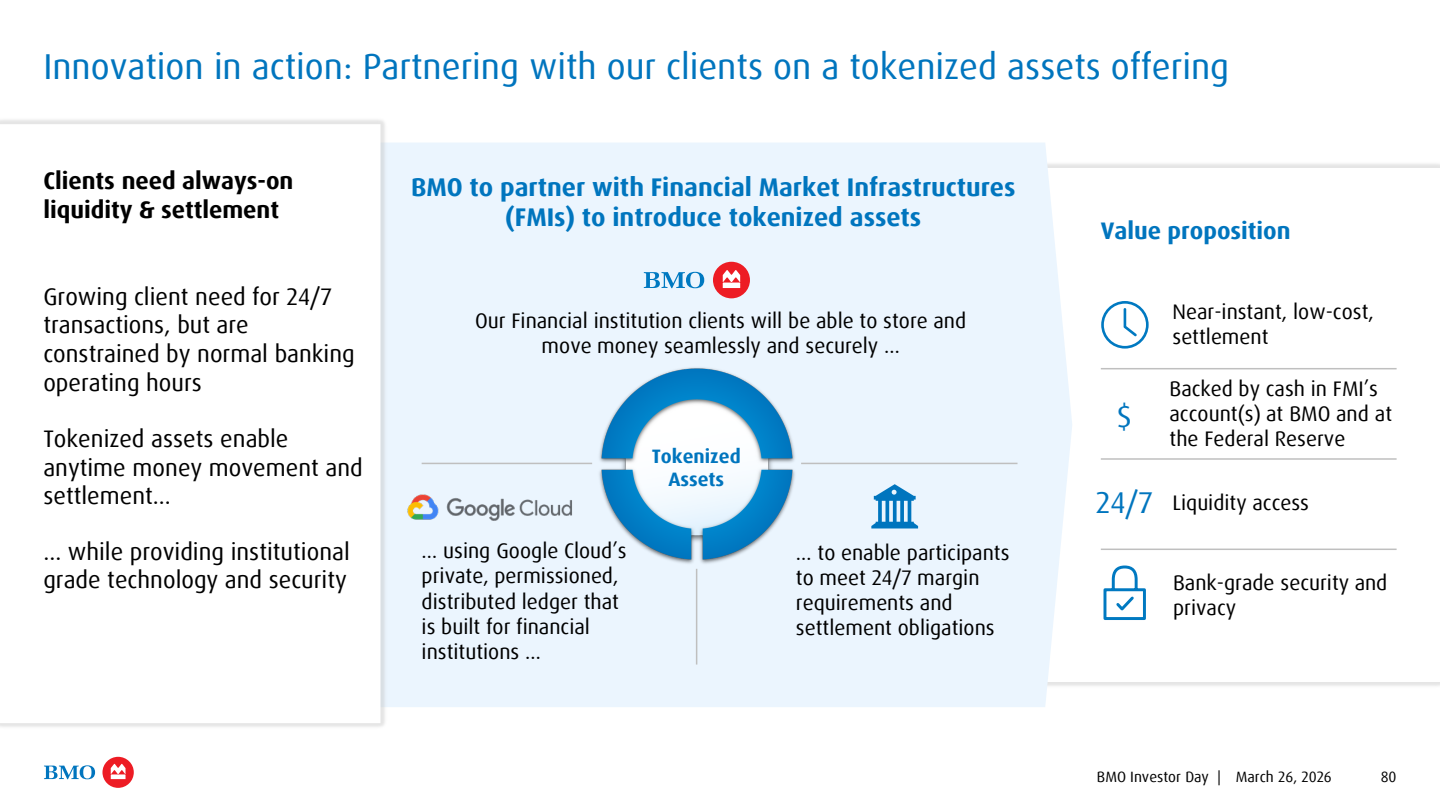
BMO's March 24 announcement identifies the intended CME permissioned network on GCUL and an H2 2026 target pending approval. Investor Day slide 80 separately describes FMI-account cash at BMO and the Federal Reserve. Those are design/announcement statements, not proof of opened or funded service accounts.
Read: 26-546, docket, BMO/CME/Google announcement, verified slide excerpt.
Possible gold and token connections
| Connection | What would happen | Evidence state at this handoff |
|---|---|---|
| Gold collateral and tokenized dollars used alongside each other | Gold supports an eligible collateral obligation; a separate dollar instrument supports another admitted cash/collateral use | Established gold framework and announced cash project; particular combined operation not demonstrated. Gold need not be tokenized. |
| Gold-backed advance funds tokenized cash | Permitted secured borrowing produces dollars, deposited into an admitted cash-token arrangement | Conditional connection. No joined advance, deposit, issuance and use was traced. |
| Digital gold itself is posted | A defined token carries acceptable gold rights/control and receives CME collateral credit | Instrument, legal bridge, custody, network and conversion must be specifically approved. No accepted digital COMEX warrant was identified. |
| Atomic gold/cash exchange | Two admitted on-ledger claims transfer together | GCUL has atomic-processing capability; the gold title/control and payment terms for such a CME transaction were not established. |
The main unresolved relationship is the link between the existing financing/control system and a particular tokenized transaction. Sharing a parent, bank, technology vendor or date does not complete that link.
Records and what each change means
| Record or asset | What it establishes | What it does not establish by itself |
|---|---|---|
| Depository inventory report | Reported stock/status at a stated activity date | Beneficial ownership, available free float, an executed loan or token reserves. |
| Electronic warrant and depository transfer confirmation | Title/control evidence in the existing gold process | A GCUL record, an unrestricted asset while pledged or cash payment. |
| CME performance-bond credit | Amount recognized toward the permitted collateral obligation | Spendable cash or payment of a separate variation obligation. |
| Executed lending agreement | Rights, commitments, conditions and specified funding routes | A particular draw or the allocation of its proceeds to tokens. |
| Bank account balance | A claim recorded at the relevant bank and date | The token holder's precise creditor claim or automatic 24/7 external redemption. |
| GCUL transaction certificate | Finalized technical attempt and its OK/failed execution result | Legal payment discharge or the absence of an off-ledger obligation. |
| CME settlement-bank debit/credit under Rule 814 | The rule's specified payment/finality event | A universal rule for every token, country or payment network. |
| Accounting and interest reports | Institution-specific balances, accruals and distributions | One shared journal across the bank, CME, depository and ledger. |
This is why collateral posting, settlement variation, secured borrowing, token issuance, transfer, redemption and physical withdrawal remain separate actions in the research.
What Google changes
The GCUL product exposes platform, currency-operator, account-manager, token-manager and settlement roles. These are technical roles; a GCUL account named “clearinghouse” is not thereby a registered CCP. Google's service terms put the domain rulebook and role assignments with the currency operator. The exact CME/BMO deployment and participant rulebook still need identification.
Two supported modes have materially different money paths:
- Deferred: off-ledger funds are tracked and the ledger is periodically synchronized.
- Instant: a single fund pool is allocated between token managers by the ledger.
The separate Crypto Finance Swiss-franc pilot chose deferred settlement while presenting instant customer transfers. It illustrates one configuration; it does not select CME/BMO's mode. The provider account also describes digital collateral expanding issuance capacity as a future enhancement, not an executed CME/gold use.
Read: evidence IDs gcul-overview, gcul-terms, gcul-account, gcul-client and swiss-comparator.
The clocks and amounts that must keep their dates
| Native date or window | Item | How to reuse it |
|---|---|---|
| November 4, 2019, recorded in the 2021 filing | Earlier house-origin warrant-rule changes took effect | Historical lineage; not a 2026 launch. |
| March 3, 2021 / April 28, 2021 | Customer-origin filing / implementation | Filing, anticipated certification and implementation are distinct. |
| 2021 filing rationale | 15% haircut used a two-day liquidation horizon and cost buffer | Historical explanation; current haircut was separately checked. The old $750m cap is not today's reviewed $1.25bn cap. |
| March 20, 2025 | Ordinary cash-interest FAQ | Daily balance/accrual and monthly payment description; not automatically new-token terms. |
| March 25, 2025 | CME/Google first integration/testing phase reported complete | Testing, with later participant testing and 2026 service intention. |
| March 24 and 26, 2026 | BMO project announcement and Investor Day slide | Planned offering/design; H2 target pending approval. |
| April 22, 2026 | Credit agreement Amendment No. 11 executed | Existing signed facility, with its own conditions and Business Day funding requirement. |
| September 30, 2026 | CME reported $139.1bn at FRB Chicago | Collateral/guaranty-fund cash at that date; not GCUL supply or BMO reserves. |
| 2026 Q3 | $1,391.7m cash-collateral earnings and $1,269.0m distribution expense | Portfolio-level reported amounts. $122.7m is arithmetic difference before other costs/taxes, not GCUL revenue. |
| October 26, 2026 | Google/Crypto Finance Swiss pilot account | Provider-reported separate pilot, with deferred interbank settlement and some manual steps. |
| November 12, 2026 | CME 26-546 submitted | Proposed policies; seven underlying exhibit amendments redacted. |
| November 25, 2026 | Docket, bank-roster, eligibility and timetable checks | Inspection dates; do not invent approval or launch dates from them. |
| Ordinary posted timetable | Gold-warrant requests 1 p.m. CT; noncash 2 p.m.; USD cash 2:30 p.m. | Subject to the timetable's exceptions; no new GCUL schedule inferred. |
A bank holiday does not mean every payment rail is closed. For the actual funding question use the relevant obligation, account access, amount, permitted payment form and rail. See the weekend funding study and continuous markets/Fed liquidity reading.
A compact example to retain
Assume eligible warrants worth $10 million. A 15% margin haircut produces $8.5 million of collateral value, subject to other limits. A separate $2 million variation payment still needs an accepted payment instrument and funding.
If a loan must be drawn first, its lending calendar and conditions matter. If incoming tokens can discharge the obligation and be reused, that may reduce immediate external cash movement. If the recipient needs bank dollars, exit/redemption still matters. None of those conditional outcomes was observed in a named BMO/CME gold transaction. Do not apply the margin haircut as an assumed loan advance rate.
Next evidence and where to put it
| Question | Source that would change the answer | Existing return |
|---|---|---|
| Has 26-546 passed review and been implemented? | CFTC disposition plus CME effective/implementation notice | ret-cme-26-546-tokenized-collateral-implementation |
| Which asset, token and network are admitted? | Marketplace acceptance notice, specific token/DLT approval and applicable limits | Same return; preserve separate acceptance and first-use dates. |
| Who issues/owes the BMO token? | Issuer/customer terms identifying the legal entity, account structure and holder rights | ret-cme-bmo-gcul-cash-production-2026 |
| Does it pay variation or only satisfy collateral? | Operative CME payment/acceptance terms and credited transaction | Same BMO return; Rule 814 remains relevant. |
| Does gold-backed funding reach token issuance? | Attributed advance, correct borrower/account, deposited proceeds, issuance and admitted use | Same BMO return; no duplicate general “gold token” watch needed. |
| What controls a digital gold interest? | Named instrument and authoritative title/control, depository/custody and conversion arrangements | Same 26-546/BMO returns as applicable; use the gold-collateral thread. |
| Who supplies off-hours dollars and handles failure? | Funding/redemption schedules, credit undertaking and performed payout/conversion/unwind | Same BMO return; distinguish liquidity from insufficient assets or an insolvent obligor. |
| Who receives interest and pays fees? | Product/bank/network terms covering reserves, accrual, allocation and transfer/redemption | Same BMO return; ordinary interest terms are not automatically imported. |
The Return Ledger holds these existing source-triggered questions. No automation or new schedule is created by this map.
Useful neighbors that retain separate evidence
| Neighbor | Why it helps | Boundary |
|---|---|---|
| November 24 CME metals review | Products, margins, warrant fees, stock statuses and technical clocks | Greater trading access or a margin-rate change does not prove token adoption. |
| London PGI in the November 24 review | Reported live proprietary-gold trading/settlement/collateral pilot; completion November 17, publication November 24 | Separate framework; no CME acceptance of PGI established. |
| Major Bank Digital Transition | BMO and other banks' distinct money, custody and participant-rights work | A bank brand may act through different legal entities and projects. |
| Connected financial reading guide | Functions, source context, money claims, records, books and remedy | A method, not proof that projects share an implementation. |
| COMEX/Crypto Hub crosswalk | Acceptance, reuse, exit and failure comparisons | Do not import another token's issuer, redemption rights or network into GCUL. |
Accounting remains a parallel research route until a source demonstrates an actual books, measurement, reconciliation, correction or assurance consequence. Astrology, X attention and Q are separate lanes; this map is factual research navigation.
Restart route for a future chat
From the Chronicle vault:
python3 "99 - Templates/library_lookup.py" "CME BMO Google gold collateral" --research --context-only
Then follow the stable map, the detailed report and the source ledger. Use normal --research lookup when searching for a specific evidence question; the context-only packet is orientation, not a negative evidence search.
Resolve current paths through 00 - Index/LIBRARY SPINE.json. The core factual thread IDs are:
- bmo-cme-gcul — announced cash instrument, account/claim, acceptance and production.
- comex-warrants-cme-collateral — title, pledge, haircut, lender security and potential token bridge.
- tokenized-collateral-stress — conversion, funding, custody and failure comparisons; no observed stress event inferred.
- clock-mismatch — broader operating-hours question; its authored chronology has a separate scope and source anchors.
- london-pooled-gold-interests and cme-globex-cloud — useful neighboring threads, not shared-deployment evidence.
The first three threads had no authored story_file at this handoff. Their current subject home is Prime brokerage, custody & clearing with the rails storyline; London's PGI thread retains its Gold & precious metals home and monetary storyline. Follow the current register if a later approved placement changes. Do not merge or re-home them merely to match this context map.
Maintain the context without losing the investigation
Keep wholesale-metals as primary factual owner and major-bank-digital-transition as the documented secondary join. Update a source-backed answer before its map summary. The structured companion records hashes of the controlling report and evidence ledger as inspected for this mapping; if they change, reread them before relying on the map's factual synopsis.
When a future source arrives, record its native date, exact actor, instrument, stage and the particular claim changed. Preserve prior snapshots. Reconcile affected Catalog/Registry, existing returns, threads and crosswalk under the shared research workflow. Do not promote an announcement to operation, an approval to first use, a permission to an observed balance, a ledger transfer to payment, or a cash account to a token reserve without the corresponding source.
The supporting research remains saved even when no new public development is found. Private projections, the installed app and the public Library have separate delivery states. This map is a private canonical entrance; it does not by itself publish or ship anything.