Biden cybersecurity orders and later changes
Full saved reading
View cited sources (36)
These are the sources cited by this reading. Each source keeps its own date and scope.
- EO 14028
- Signed original charter
- official establishment notice
- Signed renewal
- House inquiry
- EO 14144
- EO 14306
- NIST responsibilities
- EO 14306, §2
- NIST timeline
- July 30 release
- 2023 solicitation
- NCCoE project
- Draft controls
- Final release
- Draft and document history
- NIST publications index
- CISA bulletin
- CISA tables
- OMB M-26-15, §3(C)(4)
- OMB M-26-15, Appendix A §4 and Appendix B §2
- NSA NSS transition
- Data.gov TrojAI record
- NIST dataset and server details
- Los Alamos data
- January CISA playbook
- October NIST release
- Practices 9.1–9.3
- NIST OSCAL draft
- CISA ScubaGear
- FedRAMP rules
- FCC notice
- Acquisition.gov
- FAR deviation index
- FAR agenda
- Official OFAC notice
Saved research reading. Its original dates and claim limits control; the export date does not refresh the evidence.
Saved source details
---
title: Biden cybersecurity orders and later changes
status: current
artifact_role: answer
research_id: executive-order-source-library
evidence_cutoff: 2026-11-15
---
Biden cybersecurity orders and later changes
The two linked cybersecurity orders now have complete official texts and 18 section-specific directive paths. The main entity finding is that the Cyber Safety Review Board’s May 12, 2021 establishment direction, September 21 signed charter, February 3, 2022 public notice and September 21, 2023 renewal are separate events. The main status finding is that EO 14306 selectively amends EO 14144; it does not revoke the whole order.
This subwave brings Biden coverage to 133 of 162 orders and 444 directive paths; 29 parents remain. It adds one signed-charter date record and five movement records on eight exact routes. The existing Trump-format notes retain the original bodies, empty user-note sections and central hub links.
The Board was chartered after the order directed its establishment
EO 14028 §5 directs the Homeland Security Secretary, consulting the Attorney General, to establish a Cyber Safety Review Board under Homeland Security Act §871. It defines an advisory incident-review function, federal/private participation, differentiated chair and deputy-chair roles, a conditional OMB role and protected-information limits. Its first-review and report clocks have their own triggers; the order’s signing is not substituted for the Board’s actual charter date. EO 14028.
The Secretary signed the original charter on September 21, 2021. The official February 3, 2022 establishment notice independently identifies that charter date. The charter makes the Board solely advisory, exempts it from the entire FACA, provides a ceiling of 20 standing members and assigns appointment and administrative management/support/funding roles to the CISA Director. These provisions do not make the Board an independent NTSB equivalent or confer subpoena power. Signed original charter, §§2, 4–6, 11, 15 and signature; official establishment notice.
The September 21, 2023 renewal charter changes details beyond the date. It expressly includes ONCD representation; specifies a quorum and voting procedures; changes the report route and describes Presidential Communications Privilege; and describes an enacted funding level of $3.2 million including seven full-time equivalents. The original charter’s estimate was $2.8 million and five full-time equivalents. These are charter descriptions, not independent receipts of spending or filled staff. Signed renewal, §§6–7, 11–13, 16 and signature.
The reviewed renewal lasts two years unless terminated earlier or renewed again. Its scheduled two-year limit is September 21, 2025; that computed anniversary is not proof of actual termination. No later renewal, current roster or Secretary termination instrument was verified through the board section's October 30, 2026 cutoff. A March 13, 2025 House letter requests a structural review and describes membership disbanding, but its citation for that action is a news article. The letter is primary evidence of the congressional request, not independent agency-action proof. House inquiry.
The entity record therefore carries the signed charter date and separate direction, publication, renewal and scheduled-limit clocks. CISA management/support/funding and DHS reporting are mapped as roles; a narrower administrative-home or SFFAS classification is not inferred from them. The body remains an explicit no-tree-join record. Existing statutory ONCD and the existing GSA FedRAMP program are not treated as new agencies founded by EO 14028.
EO 14028 directs security work through different legal and implementation steps
The order’s other seven paths distinguish contractor threat-sharing and proposed FAR clauses; zero trust/cloud/MFA/encryption plans; software-security guidance, SBOM/attestation and labeling pilots; incident-response playbooks; civilian EDR and separate NSS work; logging policy; and definitions/statutory authority limits. Some deadlines run from later recommendations, receipt or publication rather than signing. A recommended contract clause is not an adopted FAR rule, and an EDR direction is not evidence of a deployed system. EO 14028, §§2–4, 6–11.
The civilian and national-security-system lanes remain distinct. The source preserves National Manager and other statutory authorities and does not grant control over criminal investigations or unrestricted access to every private network. The Zero Trust definition’s unusual final wording is preserved exactly as published; the raw text and PDF agree, so it is not silently completed.
The January 2025 cyber order was selectively rewritten in June
EO 14144 was signed January 16, 2025 and published January 17. Its original text covers software supply chains, endpoint/cloud/civil-space security, routing and encryption, digital identity/fraud, defensive AI, policy alignment, national security exceptions and cyber-sanctions criteria. These are original historical directions. EO 14144.
EO 14306 was signed June 6, 2025 and published June 11. The hub records it as a selective amendment, with exact affected sections and a version ledger. EO 14306.
| Original January topic | June amendment command and consequence |
|---|---|
| Software §2 | Deletes original §2(a)–(b), redesignates the remaining subsections and replaces specified NIST tasks/deadlines. The original attestation/FAR workflow is not presented as unchanged. |
| Federal systems §3 | Deletes original §3(a)–(b), redesignates the remaining subsections and removes specified text. Conditional working-group directions are not actual formation receipts. |
| Routing/email §4 | Deletes the named BGP-guidance and email-transport provisions. |
| PQC/TLS §4(f) | Replaces the provision with category-list and TLS-requirement milestones. The January 2, 2030 TLS 1.3 outer date remains. The original automatic category-to-solicitation, immediate key-migration and foreign-engagement clauses are absent from the replacement. |
| Digital identity/fraud original §5 | Deletes the entire section. This does not establish that all identity/fraud work under other authorities ceased. |
| Defensive AI original §6 | Expressly replaces former §6/new §5 with existing-dataset access and vulnerability/incident-process duties. Original Energy challenge-dependent pilot, Defense program and research-priority/funding directions are not carried unchanged into this replacement. |
| Policy/practice and NSS | Replaces the designated clauses and makes a named NSS-space deletion. The literal published references remain in the ledger. |
| EO 13694 sanctions clauses | Changes “any person” to “any foreign person” in the two specified clauses. This is a criteria change, not an actual designation or asset seizure. |
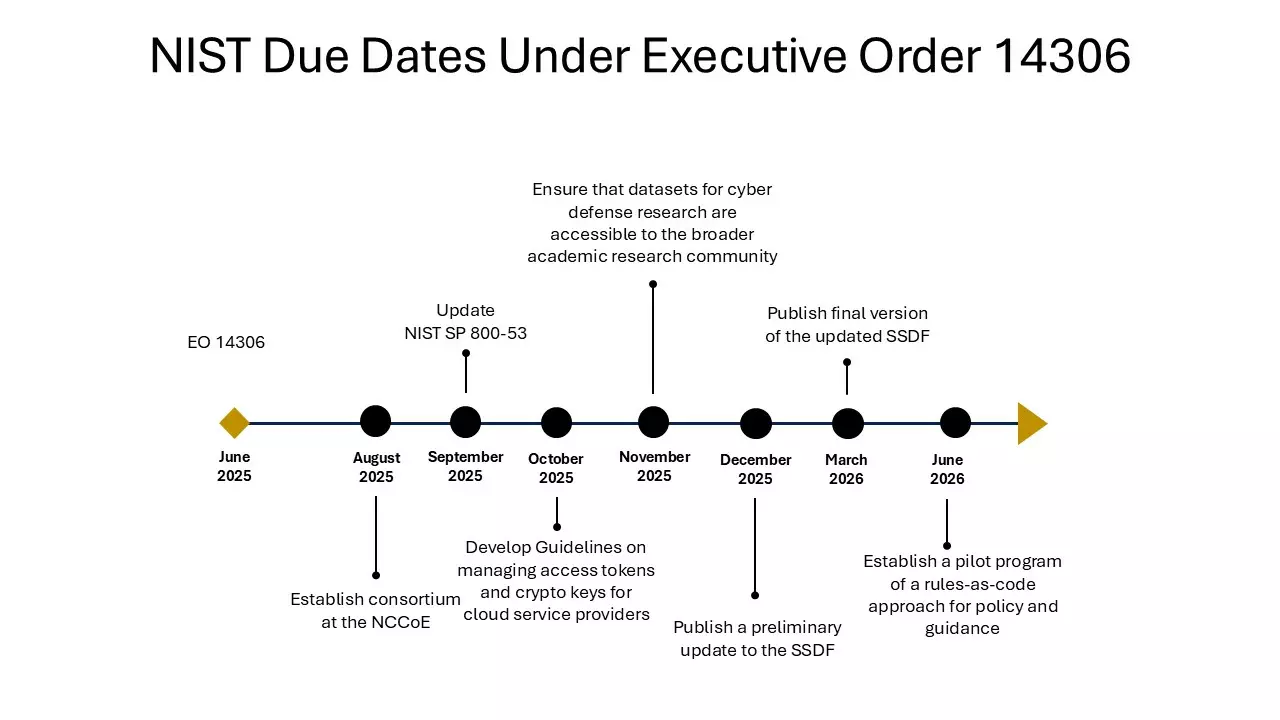
The published amendment combines section redesignations with later references to old section numbers. Only the AI replacement explicitly says “former section 6 (new section 5).” The map preserves those commands and original-topic coordinates rather than silently manufacturing a definitive consolidated legal edition. NIST’s official page independently describes its software, patch/key-management, research-dataset and rules-as-code duties under EO 14306; that agency responsibility summary is a separate object from the legal text and from proof of completion. EO 14306, §§1–3; NIST responsibilities, updated January 13, 2026.
EO 14306 public implementation records through November 15, 2026
The section numbers below refer to the amended text inserted into EO 14144. Section 2(f) of EO 14306 supplies relative clocks for the §7 actions. January 16, 2026 follows from reading the one-year clock in the amended January 16, 2025 order. June 6, 2026 follows from an anchor at the June amendment. The order gives no express reset or fixed date for those clocks. NIST's published timeline places its §7(b) rules-as-code pilot in June 2026, consistent with the June anchor for that action. The timeline gives a month and covers NIST's responsibilities. EO 14306, §2 · NIST responsibilities · NIST timeline
Secure software consortium, patch controls and SSDF
| Amended provision | Order date | Published result |
|---|---|---|
| §2(c)(i), NCCoE industry consortium | August 1, 2025 | On July 30, 2025, NCCoE identified 14 collaborating companies and published draft SP 1800-44 Volume A. The consortium developed through a May 15, 2023 solicitation and agreements with participating companies. The official project page lists continued work on SSDF mappings and proof-of-concept CI/CD deployment and gives the project status as “Reviewing Comments.” The July release establishes activity by the August deadline. The first agreement date and a final practice guide are absent from the cited public records. July 30 release · 2023 solicitation · NCCoE project |
| §2(c)(ii), secure and reliable software patches | September 2, 2025 | NIST published draft controls July 22 and finalized SP 800-53 Release 5.2.0 on August 27, 2025. It adds controls for development resiliency, developer testing and update management. SP 800-53A has the corresponding assessment changes. SP 800-53B baseline content had no changes in that release. Draft controls · Final release |
| §2(c)(iii), Secure Software Development Framework | December 1, 2025 preliminary update | NIST released the initial public draft December 17, 2025, as SP 800-218 Rev. 1, SSDF version 1.2. The order allows 120 days from publication for the final version, which computes to April 16, 2026. NIST's publications index still lists version 1.2 as Draft and version 1.1 as Final. No final version 1.2 was located through November 15. Draft and document history · NIST publications index |
Post-quantum product categories and TLS
For §4(f)(i), CISA issued its product-category guidance January 23, 2026, after the December 1, 2025 deadline. CISA's noon Eastern Standard Time bulletin expressly links the release to EO 14306. Table 2 identifies four categories with widely available products supporting some PQC functions. They cover cloud infrastructure and platform services, chat and messaging, browsers and web servers, and endpoint data-at-rest and full-disk encryption. Table 3 separately lists categories still transitioning. The guidance excludes operational technology and the Internet of Things. OMB later cited the CISA guidance in M-26-15 §3(C)(4) and advised agencies to include PQC integration in product requirements for these categories. CISA bulletin · CISA tables · OMB M-26-15, §3(C)(4)
For §4(f)(ii), OMB's June 24, 2026 M-26-15 Appendix A §4 expressly directs agencies to support TLS 1.3 or its successor on non-NSS as soon as practicable and by January 2, 2030. Appendix B requires each initial migration plan to schedule testing and deployment. No public OMB requirement issued by the December 1, 2025 deadline or distinct NSA issuance imposing this same protocol requirement for NSS was located through November 15. NSA's October public materials document the separate CNSA 2.0 algorithm and product transition. OMB M-26-15, Appendix A §4 and Appendix B §2 · NSA NSS transition
Cyber-defense datasets and AI vulnerability reporting
Amended §5(a) calls for feasible academic access to existing cyber-defense datasets by November 1, 2025, including secure access where appropriate. Data.gov records September 9, 2025 as the publication date of NIST's public TrojAI test dataset for botnet command-and-control and benign network-traffic classifiers. The NIST documentation links training, test and holdout data and separately describes a 48-model set held on the Evaluation Server. Los Alamos National Laboratory separately publishes cyber-defense datasets, including 58 days of de-identified security events. The public records show specific access routes. No cross-agency dataset inventory or report showing completion of §5(a) was located through November 15. Data.gov TrojAI record · NIST dataset and server details · Los Alamos data
Amended §5(b) directs Defense, Homeland Security and the Director of National Intelligence to add AI software vulnerabilities and compromises to existing agency processes by November 1, 2025, including indicator sharing. CISA published its voluntary industry reporting playbook on January 14, 2025, before EO 14144. On October 16, 2026, NIST, NSA and CISA issued voluntary practices under the 2025 AI Action Plan for incidents in frontier-model training and evaluation. Practices 9.1–9.3 preserve existing reporting obligations, use established channels for software vulnerabilities, and recommend voluntary sharing of incident information with NIST and NSA. No public record through November 15 established incorporation in the three named principals' agency-wide processes or actual indicator exchange under §5(b). January CISA playbook · October NIST release · Practices 9.1–9.3
Rules-as-code pilot and Cyber Trust Mark procurement
For amended §7(b), the public machine-readable work includes NIST's December 2, 2025 draft white paper on the Open Security Controls Assessment Language, CISA's ScubaGear automated checks for Microsoft 365, and FedRAMP's 2026 machine-readable rules. The public records reviewed through November 15 did not identify a launch instrument, participant list or test output for the specific OMB–NIST–CISA joint pilot. NIST OSCAL draft · CISA ScubaGear · FedRAMP rules
Amended §7(c) directs the agency members of the FAR Council to jointly take steps within one year toward a FAR amendment that would require covered consumer Internet of Things product vendors to carry U.S. Cyber Trust Mark labeling by January 4, 2027. The FCC's October 27, 2026 notice DA 26-1162, PS Docket 23-239, requested comment on design, renewal and post-market surveillance for the voluntary labeling program. The FAR publication index, agency deviation index, FAR agenda and Federal Register showed no public Cyber Trust Mark FAR case, proposal, final rule or class deviation through November 15. Internal FAR Council coordination remains unverified. FCC notice · Acquisition.gov · FAR deviation index · FAR agenda
The Annex language points to an inherited sanctions list
All 32 pages of the two official parent PDFs were read against the raw texts and their final signed pages visually checked. Neither has an attached Annex, appendix or schedule. Two references in EO 14144 need explicit treatment:
- §9’s quoted “Annex to this order” belongs to EO 13694, whose §1(a) is being replaced. It is not a new Biden list. A January 5, 2017 OFAC notice identifies the inherited Annex, as amended by EO 13757, as four individuals and five entities, including GRU and FSB. That historical notice does not certify their entire current sanctions state. Official OFAC notice.
- §3’s ConOps appendix is a future endpoint-security output, requiring DOJ concurrence before the specified implementation. It is not attached to the signed order. Charter provisions for later classified report annexes likewise do not add an attachment to EO 14028 or EO 14144.
Foreign listed persons/entities are not added to the US federal entity chart. Sanctions criteria, listing, blocking, actual enforcement, seizure and government ownership remain separate objects. The goal’s nine actual Biden attachment-bearing parents remain unchanged; seven pay/military-justice attachment reads remain pending.
How this fills the existing Library
The science subwave already separates advisory governance, support, statutory foundations and operation. The cyber pair adds the more concrete signed-charter and renewal receipts while retaining the same distinction between a body’s functions and its home. The existing source-library hub and movement Registry receive exact predecessor/original/later links rather than a blanket assertion that a policy announcement produced an operating result.
All 640 prior order notes, 698 topology rows, 475 prior date rows, 84 prior movement records and prior source/status rows are preserved. The overall Trump census keeps its September 29, 2026 cutoff. This is private Workbench/Chronicle work; no public release or installed-app build is included.