What Medicare’s WISeR pilot processed and how service use changed
Full saved reading
View cited sources (13)
These are the sources cited by this reading. Each source keeps its own date and scope.
- December 10, 2025 House oversight exchange
- CMS announcement
- Federal Register
- CMS operating guide, §1.2
- CMS FOIA publication route
- Combined FOIA production, physical pp. 315, 321 and 322
- CMS FAQ
- Noridian routing and beneficiary report, physical p. 321
- DelBene's release
- CMS exemption fact sheet, p. 2
- JAMA article and date
- Publisher's result
- University of Minnesota study summary
Saved research reading. Its original dates and claim limits control; the export date does not refresh the evidence.
Saved source details
---
title: "What Medicare’s WISeR pilot processed and how service use changed"
question: "Did Original Medicare use AI-assisted prior authorization under WISeR, and what happened to use of care?"
status: current
artifact_role: answer
research_id: great-healthcare-plan-2026
evidence_cutoff: 2026-11-11
---
What Medicare’s WISeR pilot processed and how service use changed
Bottom line. WISeR put selected Original Medicare services through technology-assisted review in six states. Noridian recorded 20,397 year-to-date prior authorization decisions from its Washington and Arizona participants in a March 30 report. An independent study found less use of targeted services in the first six months. The evidence leaves open whether the forgone services were medically necessary and how patient outcomes changed across the pilot.
When review began. CMS announced the model on June 27, 2025. The Federal Register published notice on July 1, 2025. The six-state test began January 1, 2026 in Arizona, New Jersey, Ohio, Oklahoma, Texas and Washington. Model participants and Medicare Administrative Contractors began accepting prior authorization requests on January 5, 2026 for services furnished on or after January 15, 2026. The December 10, 2025 House oversight exchange records access concerns before launch. CMS announcement · Federal Register · CMS operating guide, §1.2
Actual intake. The request-volume workbook released by CMS under FOIA lists 632 prior authorization receipts at Noridian for January 5–11, 2026, including 498 by fax and 134 by portal. It separately shows 5 direct requests to Zyter in Arizona and 188 direct requests to Virtix in Washington for the same week. These are three reported intake lines. The workbook does not show whether any request appeared in more than one channel or how these receipts link to later decisions and care. The 2026 year follows the program and release context. The worksheet's week labels omit the year. Exact CMS workbook, Sheet1 A2:F3, A10:H11 and A19:H20 · CMS FOIA publication route
Actual decisions. Noridian's Jurisdiction F report submitted March 30, 2026 records the year-to-date prior authorization decisions it received from two model participants. The counts belong to that snapshot and cover decisions rather than unique people.
| Participant and state | Affirmed | Non-affirmed | Decisions received |
|---|---|---|---|
| Virtix, Washington | 2,863 | 3,233 | 6,096 |
| Zyter, Arizona | 11,590 | 2,711 | 14,301 |
| Noridian total | 14,453 | 5,944 | 20,397 |
The report gives 19,833 tracking numbers sent and 1,553 pending decisions as separate inventory figures. It does not provide a matched case ledger. EFF announced public release on September 8, 2026 and lists this combined PDF and the request-volume workbook on September 9, 2026. The exact date CMS delivered the files to EFF remains unverified. Native report excerpt · Combined FOIA production, physical pp. 315, 321 and 322 · EFF disclosure index
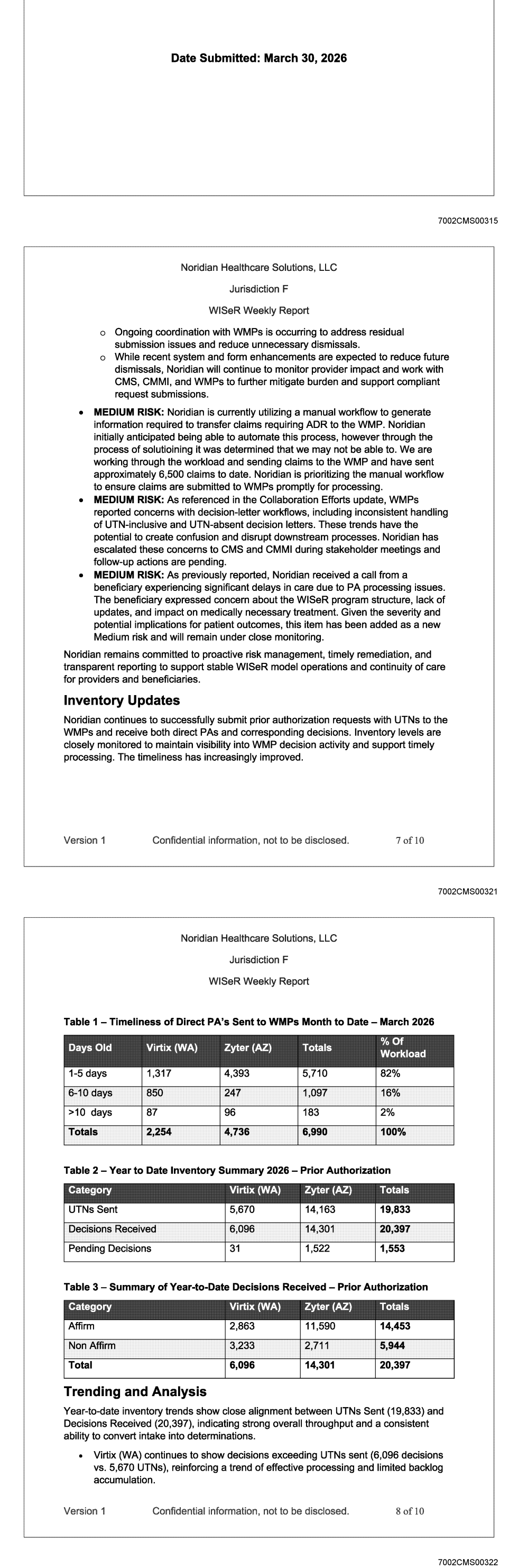
What a decision does. CMS permits technology-assisted review and requires a relevant human clinician to review every prior authorization non-affirmation. A provider can resubmit before a claim denial. When a provider furnishes a service and submits a claim with a non-affirmation on file, the Medicare contractor denies payment and ordinary appeal rights attach. A claim with no prior authorization decision goes to prepayment medical review after the service. In the same March report, Noridian said it had manually routed about 6,500 claims needing additional documentation to the model participants. It also logged one beneficiary’s report of significant care delays due to prior authorization processing. The report gives no count of resulting claim denials, paid claims, services delivered or the share of decisions using AI. CMS FAQ · CMS guide, §§7.1.2, 7.2 and 10 · Noridian routing and beneficiary report, physical p. 321
Later operating changes. On June 22, 2026 Representative Suzan DelBene reported that CMS had required Virtix to submit a corrective plan for missing the 72-hour review standard. Her release documents the reported oversight step and patient and provider accounts. It supplies no measured rate of patient delays. CMS records first exemption notices in June 2026 and a July 2026 start for qualifying providers to bypass both review paths. The CMS fact sheet gives no count of exempt providers or effect on access. DelBene's release · CMS exemption fact sheet, p. 2
Measured service use. The October 26, 2026 JAMA research letter by Hannah Neprash and Michael Barnett used Epic Cosmos to compare monthly Original Medicare treatment encounters in the six pilot states with the other states and D.C., using 2024–25 as baseline and January–June 2026 as follow-up. The authors reported 15.0% fewer epidural steroid injection encounters and 19.5% fewer encounters for the other implemented target services relative to comparison trends. Delayed-implementation services showed no significant change. These observations do not establish the appropriateness of forgone care, whether a patient received an alternative, clinical outcomes, time to treatment or the effect of the algorithm separately from the review policy. The public publisher and author summaries support these estimates. The full article was outside the accessible scope. JAMA article and date · Publisher's result · University of Minnesota study summary