The questions produce leads, but little firsthand evidence of Epstein's crimes
Hillary Clinton denies knowing about Epstein's or Maxwell's crimes, says she does not recall meeting Epstein and describes Maxwell as a casual acquaintance through Ted Waitt. The useful distinctions concern what she remembers personally, what she learned in deposition preparation and what other people's records could establish. The interview does not independently determine every Clinton-family contact or every foundation transaction. It also contains a demonstrable misattribution of an email sentence by a questioner.
Coverage: complete first reading of all 19 local machine-text chunks,0–16,511.291791seconds (4:35:11.292) of the official February26,2026 deposition recording, released March2. Oath15:53–16:00. This is the full released recording's machine-text reading, not a claim about the proceeding's elapsed wall-clock length, an official/certified written transcript or full auditory verification. Frozen derivative. Three selected English second-pass clips were checked; proper names and dates remain vulnerable to recognition error.
Primary comparisons: two complete DOJ-released email PDFs, with first-page image checks; selected actual July2025 DOJ Maxwell passages; official FEC/State Department material; an archived government account of the Jones settlement and separate sanctions; and the later June2026 Band interview. Later evidence is identified as later, rather than treated as information available during this February deposition.
One claim of personal familiarity uses the wrong author
At approximately3:58:28–3:59:00, a questioner identifies EFTA00657115 and describes a sentence about Clinton looking better in person as a comment by Epstein. Both the main recognition and a selected second pass capture that attribution. The actual two-page email, fully read with its first page visually checked, shows the sentence in a redacted correspondent's message to Epstein on September20,2011. Epstein's replies address transport and meeting logistics. It is not his own remark about seeing Clinton.
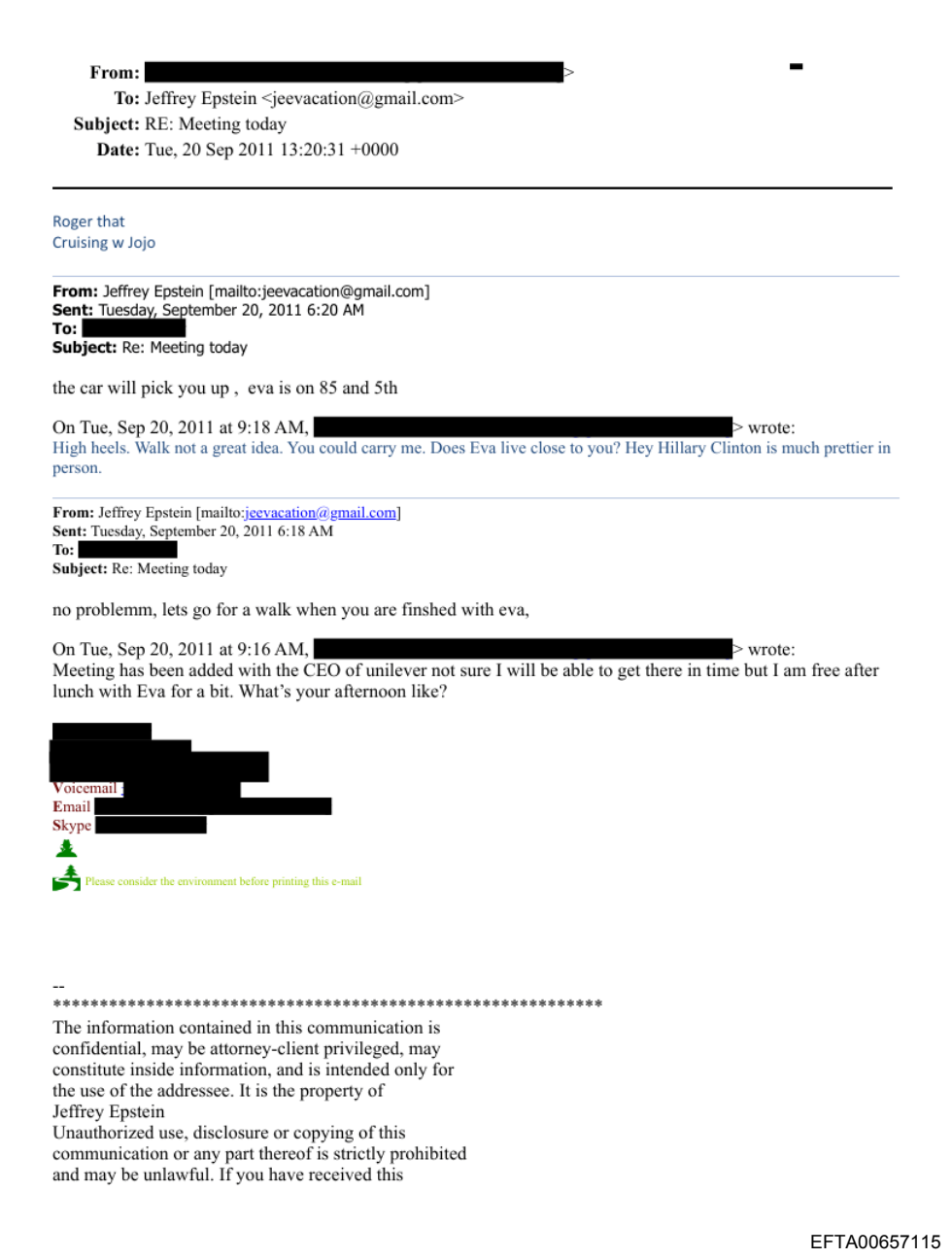
That matters: this document cannot support the particular inference that Epstein described his firsthand encounter with her. The sender's identity remains redacted; no attempt is made to identify them from incidental clues. Correcting the attribution does not establish that Clinton never met Epstein on any occasion.
The separate EFTA01949592 exchange, also fully read and image-checked, records Olivier Colom asking Epstein on November5,2013 to organize a discreet Sarkozy–Clinton meeting in New York; Epstein's November6 reply asks when and says such meetings are difficult to keep discreet. It records a request to Epstein, not a completed arrangement, Clinton's reply or proof she knew of it. At4:06–4:08 she denies prior awareness and says Sarkozy could contact her directly. Both propositions can coexist: a third party sought brokerage, and the intended participant may not have known.
No recollection is different from impossibility
Her opening at16:57–17:16 and answers around37–41minutes deny remembered contact, flights, property visits or communication with Epstein. She acknowledges learning during preparation that he apparently attended a September29,1993 White House Historical Association event. At1:37–1:39 she expressly allows that a chance hallway encounter could have occurred without her remembering it.
A visitor log or event photograph could therefore show presence at the same event without disproving the carefully qualified no-recollection answer. Conversely, those records would be important if used to test a categorical never-met formulation she sometimes uses later. Presence, greeting, private meeting and ongoing relationship should not be collapsed. The actual White House visitor appointments, attendance and photographs were not independently reconstructed in this wave.
The long name list at26–32minutes asks whether she communicated about Epstein or Maxwell, not whether she knew every listed person. Some answers are qualified by recollection or preparation discussions. Treating all the negatives as denials of any acquaintance would misstate the question.
Maxwell, Waitt and the family have different relationship clocks
At33–37minutes she describes Maxwell mainly as Waitt's girlfriend and says2010 is the last occasion she recalls. Her tentative first-date suggestion is not a firm assertion that no earlier contact occurred. She does not recall a possible East Coast flight, does not rule it out, and says she was not present for alleged Chappaqua visits (1:45–1:46). She acknowledges the wedding photograph and describes Maxwell as Waitt's guest, without recalling a conversation there (1:43–1:44).
The actual DOJ Day2 transcript, PDF44–50, printed259–265, confirms that Maxwell's own flight recollection is tentative and that she claims several invited Chappaqua visits. It also confirms she says she did not see Epstein with Hillary Clinton. These are Maxwell's answers, not independently verified itinerary facts. The Waitt interview supplies a separately recalled Washington political meeting around2007 and uncertainty about another residence; do not merge Washington and Chappaqua or turn either uncertain date into a clean contradiction.
Her accounts of Chelsea's friendship, Bill's contact, the2010 breakup and2014 Maxwell lunch include matters she did not personally observe or learned during preparation. At4:04 she acknowledges being told about the2014 lunch. Her own last remembered contact in2010 is not a denial that Bill met Maxwell later. The actual guest list, invitations, travel logs and meeting correspondence are the better tests.
CGI creation, financial support and event access need separate records
She says she was not involved in the foundation/CGI's early operational setup while serving in the Senate, became active after leaving State in2013, and discussed broad ideas with Bill. At55–64minutes she attributes the CGI concept to his reaction to Davos, but repeatedly says she does not know what contribution Maxwell or Epstein may have made. This is not a categorical factual denial that either helped. Spousal-communication objections also limit some questions; general discussion of a concept is different from knowing every organizer, introduction or payment.
The actual DOJ Maxwell passage adds an omitted qualification: after describing herself as central to bringing people together, Maxwell says CGI was not her idea and that they had already had it (Day2 PDF49, printed264). Her claim of introductions and Hillary's claim of Bill's concept are not inherently mutually exclusive. The July6,2007 defense letter characterizing Epstein's role, as quoted in this deposition, is advocacy by his lawyer, not a contemporaneous CGI organizational instrument. That complete letter, named introductions and founding correspondence remain needed.
A question about a reported$1million payment to Publicis receives a no-knowledge answer at2:58; a third-party service payment cannot simply become a direct Clinton Foundation donation. The raw machine year here is unreliable and is not used as an event date. Original instructions, bank receipt, payer, beneficiary and contract are still required.
Likewise, a2013 TerraMar commitment, complimentary access, an award and foundation funding are different objects. She denies organizing or remembering Maxwell's appearance. Her general staff-planning account does not establish who selected that particular participant. The original2013 program/commitment record and approvals remain unrecovered here. At3:56–3:58 she corrects a questioner's claim that she had acknowledged meeting Maxwell at CGI: she had not done so.
Invitations and donations do not prove her personal knowledge
At1:17–1:19 a September30,2014 email is read as an invitation to a Lowey fundraiser featuring Hillary Clinton, with a reply declining for Jeffrey. She says she attended to support Lowey and did not know the invitation. The chain itself was not separately recovered. It would still distinguish invitee, acceptance, attendance, recipient of proceeds and personal solicitation.
A later Cantor Fitzgerald/Lutnick chain is invoked to challenge her denial of solicitation. The last clarification at4:33:08–4:33:38 says the committee understands the chain ran Lutnick→Groff→Epstein and did not include Hillary Clinton; she agrees that is her understanding. That clarification does not prove she never authorized fundraising, but it defeats treating the quoted chain alone as her direct email request.
She acknowledges learning during preparation of a reported$20,0001999 joint-fundraising contribution, not a direct presidential-campaign payment. A questioner later corrects the presidential-campaign description to the Senate race (2:54–2:55). Maxwell's reported$2,3002007 contribution and the foundation's reported$25,000 receipt are separate categories; original FEC/charity entries were not audited in this wave.
Her suggestion that joint fundraising categorically barred campaign communication/coordination is not a sound general explanation. The FEC's official guidance describes participating committees, written allocations, shared records and authorized fundraising representatives. That current guidance is not a substitute for the exact1999 rules, agreement and allocation. No rule inference proves whether she actually knew this donor. Trace gross receipt and allocation rather than assuming all$20,000 was a direct personal-campaign receipt or unrelated to her candidacy.
Island allegations must be tested against the original source and its date
She denies visiting the island and says she understands Bill did not visit. Her references to Secret Service coverage are her understanding; they are not the original deployment or protection-waiver records. Names absent from a flight log do not by themselves prove absence of protection, and never formally waiving protection is not itself a complete itinerary reconstruction.
At2:49 a questioner invokes Band's reported2020 island claim and she says she thinks it false. Later evidence: the actual June30,2026 Band transcript, PDF27–28 in the saved text, says he has no information Bill visited, cannot recall the exact Vanity Fair conversations or whether he sought correction. That later qualified answer neither independently proves the earlier quotation false nor supplies firsthand corroboration of a visit. Do not keep presenting the reported2020 claim as Band's unqualified current sworn position.
The FBI interview excerpt entered near4:15 is a witness report of what Epstein wanted others to say. Its full context, source knowledge and attachments matter. The quoted sentence is not automatically that witness's own observation of a visit, nor a finding by the FBI. She says she had not seen it. The exact original3501.144-032/underlying account remains a recovery target; no pseudonym is joined to another case's numbered victim.
At4:18–4:22 an incomplete court exhibit is eventually identified as a search-term/forensic-discovery submission in Giuffre v. Maxwell. The questioner expressly says it contains no allegations against her. A proposed search term is not a list of defendants, a finding of misconduct or proof responsive communications exist. The case's2015 identity and later unsealing/publication dates must remain distinct; “filedJanuary2024” is not proof the lawsuit began then.
Both sides make claims this interview cannot independently establish
Her attacks on DOJ's completeness and motives, and members' assertions that the current release disproves cover-up or that earlier releases were zero, are political/evidentiary arguments. Neither is a file-by-file production audit. The separate Bondi/statute comparison gives a stronger starting point. Interviewing a source four times or protecting a source does not automatically establish the truth of every accusation; it also does not establish falsity. Her suggestion of which additional witnesses to question is not proof of their guilt.
Her intelligence answers consistently deny personal official knowledge while urging examination of records. Acknowledging a hypothetical technique or proposing CIA/DNI/counterintelligence requests is not confirmation that Epstein worked for an intelligence service. The questioner who places her at State in2014 is corrected: she left in2013. Several other prompts use loose dates or labels: the NPA was2007/plea2008 rather than a2009 deal; Maxwell's arrest was2020 rather than2021; a state conviction is corrected from federal. The Acosta primary chronology controls those dates.
Her opening's2011 reference to first U.S. TIP ranking is also incorrect against her own June2010 State Department letter, which announces the first U.S. ranking. Both recognition passes render2011; this is a narrow date correction, not evidence of a knowing false statement. Broader staffing-cut and program-success claims remain attributed here, without a separate implementation audit.
The accepted question at2:24 describing the$850,000 Jones settlement as a civil liability finding also conflates outcomes. The recovered Independent Counsel government report, selected PDF5–8, distinguishes the November13,1998 settlement, the April12,1999 civil-contempt finding over discovery testimony and 2001 Arkansas five-year suspension. It notes the underlying suit had been dismissed and was on appeal at settlement. Those sanctions are real but different from a sexual-misconduct liability judgment in the Jones case; they do not resolve an Epstein allegation. This check uses the government's account, not a newly completed full Jones docket audit.
Procedure and the strength of the arguments
The photo dispute at1:19–1:28 interrupts the interview; she then resumes. The recording does not support a claim that she walked out and ended the deposition. Counsel asserts privacy/rule objections; Comer says photos/videos must not be released and that he instructed members. The second-photo complaint and counterclaim about other leaks remain procedural disputes. Original posts and the negotiated agreement would test timing and terms. Her opening's24-hour video request was a request, not proof of an agreed release deadline.
Attorney/spousal privilege, relevance objections, refusal to speculate and no recollection are different responses. In some exchanges she declines family-conversation questions while offering general information. The record does not provide a court judgment resolving every asserted boundary. The committee contempt recommendation preceding her eventual appearance is also distinct from a criminal conviction.
The committee's stronger rationale is to test contacts, access, fundraising and institutional decisions through a witness who may know them. Its weaker inference is that knowing someone who knew Epstein establishes knowledge of his crimes, or that an invitation, search term or redacted-photo caption proves a specific act. The wrong email-author premise illustrates the danger concretely.
Her stronger response identifies lack of firsthand knowledge, different office responsibilities, pretrial/publication clocks and the need to ask the actual participant. Her weaker responses are broad claims about nobody knowing, sweeping political motives, categorical credibility inferences and the imprecise joint-fundraising rule. Those overstatements should be corrected without inventing affirmative evidence of her participation.
The best remaining tests are actual visitor/event records, FEC and charity receipts/allocations, the Publicis payment and founding/CGI approvals, the original FBI interview and attachments, and dated Secret Service/travel records. The evidence reviewed supplies no substantiated firsthand account here that she participated in Epstein's crimes. That is a scoped conclusion, not a finding that every possible contact or allegation has been disproved.
Sources
Full saved reading
View cited sources (3)
These are the sources cited by this reading. Each source keeps its own date and scope.
Document details and formats
Saved research reading. Its original dates and claim limits control; the export date does not refresh the evidence.
Saved source details
---
title: "Hillary Clinton: limited firsthand knowledge and an email misattributed during questioning"
research_id: epstein-interview-statement-accountability
evidence_cutoff: 2026-10-31
event_date: 2026-02-26
status: current
---