In a 5 4 vote the Supreme Court refused
Open original post on X · More from this plotline
Captured references and cross-wing navigation · Saved media · Bounded complete reading
🚨 In a 5-4 vote, the Supreme Court refused to let President Trump remove Federal Reserve Governor Lisa Cook while litigation continues, holding that the Federal Reserve's longstanding independence from presidential control is rooted in the Nation's history and tradition. https://t.co/jQa8vWTu4y
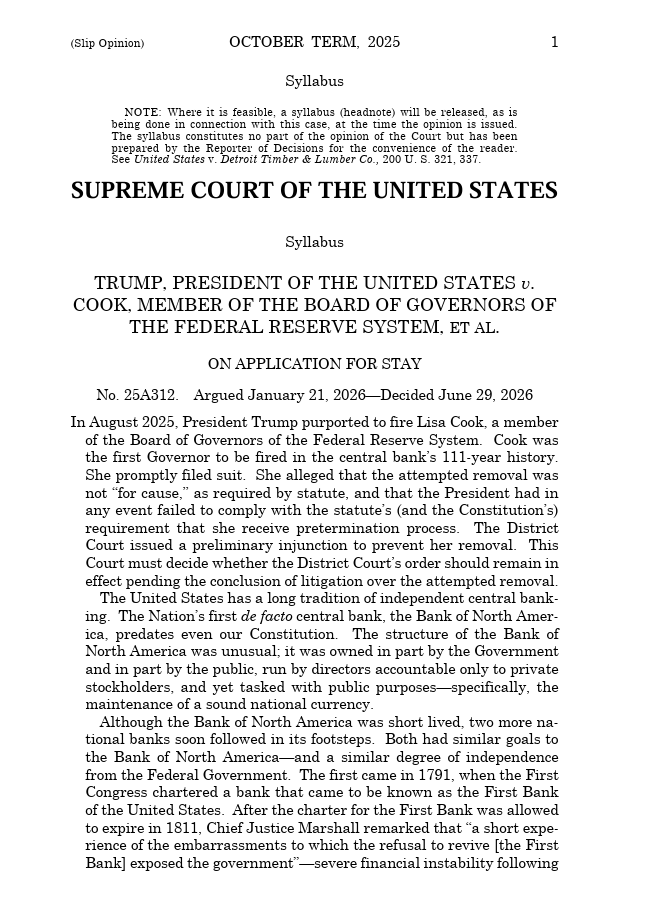
Text captured from the image
*(Transcribed from the attached screenshot.)*
Slip Opinion syllabus, OCTOBER TERM, 2025, page 1.
SUPREME COURT OF THE UNITED STATES — Syllabus
TRUMP, PRESIDENT OF THE UNITED STATES v. COOK, MEMBER OF THE BOARD OF GOVERNORS OF THE FEDERAL RESERVE SYSTEM, ET AL.
ON APPLICATION FOR STAY
No. 25A312. Argued January 21, 2026 — Decided June 29, 2026
In August 2025, President Trump purported to fire Lisa Cook, a member of the Board of Governors of the Federal Reserve System. Cook was the first Governor to be fired in the central bank's 111-year history. She promptly filed suit. She alleged that the attempted removal was not "for cause," as required by statute, and that the President had in any event failed to comply with the statute's (and the Constitution's) requirement that she receive pretermination process. The District Court issued a preliminary injunction to prevent her removal. This Court must decide whether the District Court's order should remain in effect pending the conclusion of litigation over the attempted removal.
The United States has a long tradition of independent central banking. The Nation's first de facto central bank, the Bank of North America, predates even our Constitution. The structure of the Bank of North America was unusual; it was owned in part by the Government and in part by the public, run by directors accountable only to private stockholders, and yet tasked with public purposes — specifically, the maintenance of a sound national currency.
Although the Bank of North America was short lived, two more national banks soon followed in its footsteps. Both had similar goals to the Bank of North America — and a similar degree of independence from the Federal Government. The first came in 1791, when the First Congress chartered a bank that came to be known as the First Bank of the United States. After the charter for the First Bank was allowed to expire in 1811, Chief Justice Marshall remarked that "a short experience of the embarrassments to which the refusal to revive [the First Bank] exposed the government" — severe financial instability following [text continues beyond frame].
Saved attention and attributed commentary. The Research Library holds the separate source-supported research.