In a 6 3 vote the Supreme Court struck
Open original post on X · More from this plotline
Captured references and cross-wing navigation · Saved media · Bounded complete reading
🚨 In a 6-3 vote, the Supreme Court struck down Hawaii’s rule that banned carrying guns on most private property that is open to the public unless the owner gave explicit permission, holding that it violates the Second and Fourteenth Amendments. https://t.co/yz7303UybD
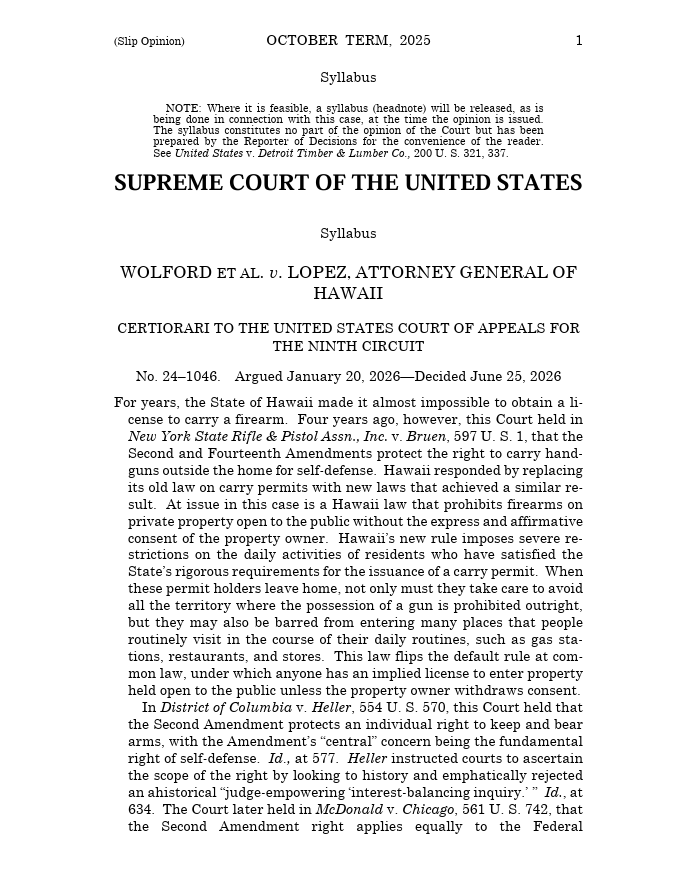
Text captured from the image
*(Transcribed from the attached screenshot.)*
Slip Opinion syllabus, OCTOBER TERM, 2025, page 1.
SUPREME COURT OF THE UNITED STATES — Syllabus
WOLFORD ET AL. v. LOPEZ, ATTORNEY GENERAL OF HAWAII
CERTIORARI TO THE UNITED STATES COURT OF APPEALS FOR THE NINTH CIRCUIT
No. 24-1046. Argued January 20, 2026 — Decided June 25, 2026
For years, the State of Hawaii made it almost impossible to obtain a license to carry a firearm. Four years ago, however, this Court held in New York State Rifle & Pistol Assn., Inc. v. Bruen, 597 U.S. 1, that the Second and Fourteenth Amendments protect the right to carry handguns outside the home for self-defense. Hawaii responded by replacing its old law on carry permits with new laws that achieved a similar result. At issue in this case is a Hawaii law that prohibits firearms on private property open to the public without the express and affirmative consent of the property owner. Hawaii's new rule imposes severe restrictions on the daily activities of residents who have satisfied the State's rigorous requirements for the issuance of a carry permit. When these permit holders leave home, not only must they take care to avoid all the territory where the possession of a gun is prohibited outright, but they may also be barred from entering many places that people routinely visit in the course of their daily routines, such as gas stations, restaurants, and stores. This law flips the default rule at common law, under which anyone has an implied license to enter property held open to the public unless the property owner withdraws consent.
In District of Columbia v. Heller, 554 U.S. 570, this Court held that the Second Amendment protects an individual right to keep and bear arms, with the Amendment's "central" concern being the fundamental right of self-defense... The Court later held in McDonald v. Chicago, 561 U.S. 742, that the Second Amendment right applies equally to the Federal [text continues beyond frame].
Saved attention and attributed commentary. The Research Library holds the separate source-supported research.