The Third Circuit has vacated a federal judges order
Open original post on X · More from this plotline
Captured references and cross-wing navigation · Saved media · Bounded complete reading
🚨 The Third Circuit has vacated a federal judge's order requiring the National Park Service to restore slavery-related exhibits at Philadelphia's President's House site. https://t.co/M05PoMACXX
Text captured from the image
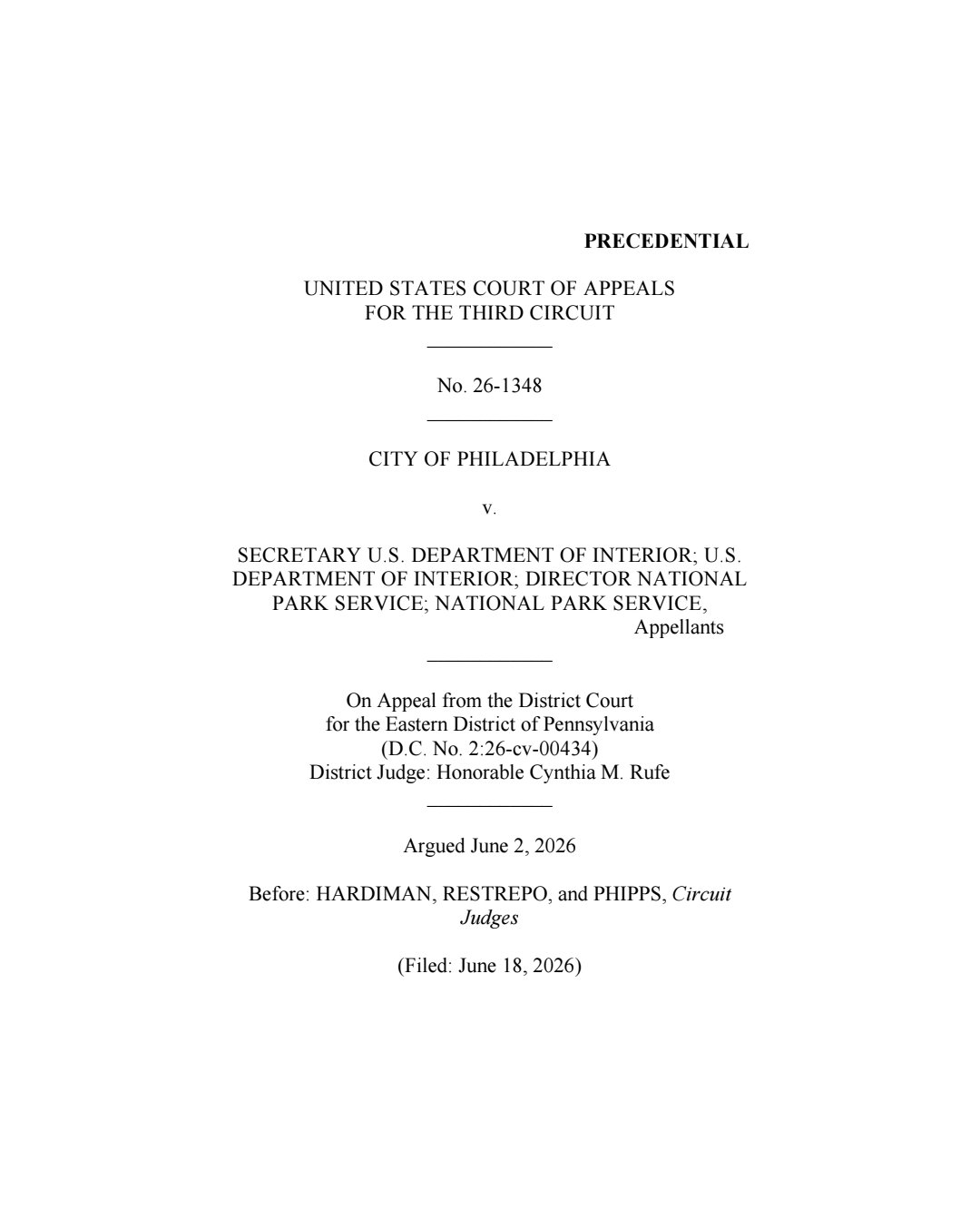
*(Transcribed from the attached screenshot.)* (Image 1 — opinion cover page)
"PRECEDENTIAL
UNITED STATES COURT OF APPEALS FOR THE THIRD CIRCUIT
No. 26-1348
CITY OF PHILADELPHIA v. SECRETARY U.S. DEPARTMENT OF INTERIOR; U.S. DEPARTMENT OF INTERIOR; DIRECTOR NATIONAL PARK SERVICE; NATIONAL PARK SERVICE, Appellants
On Appeal from the District Court for the Eastern District of Pennsylvania (D.C. No. 2:26-cv-00434), District Judge: Honorable Cynthia M. Rufe
Argued June 2, 2026
Before: HARDIMAN, RESTREPO, and PHIPPS, Circuit Judges
(Filed: June 18, 2026)"
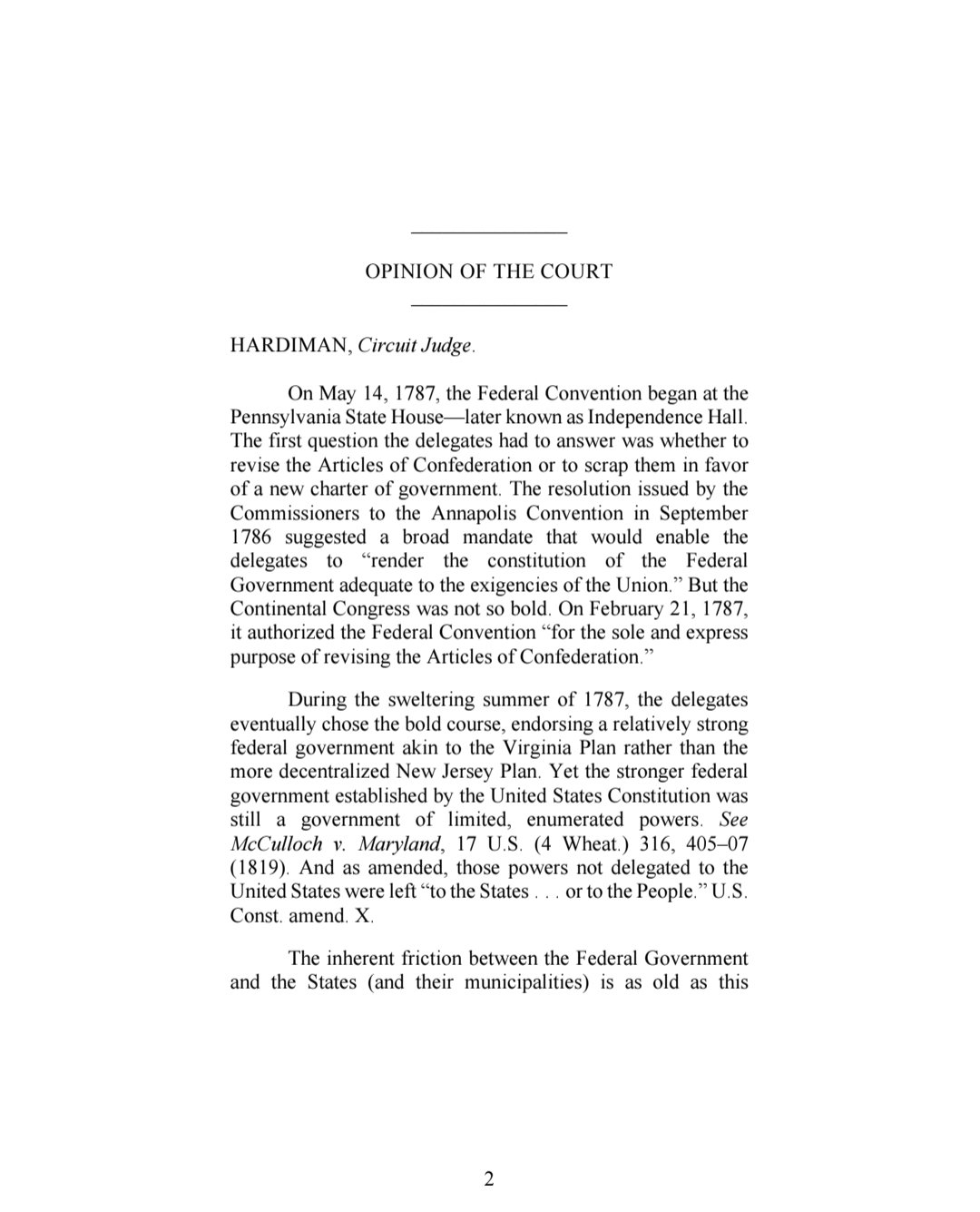
*(Transcribed from the attached screenshot.)* (Image 2 — page 2, opinion text)
"OPINION OF THE COURT
HARDIMAN, Circuit Judge.
On May 14, 1787, the Federal Convention began at the Pennsylvania State House—later known as Independence Hall. The first question the delegates had to answer was whether to revise the Articles of Confederation or to scrap them in favor of a new charter of government. The resolution issued by the Commissioners to the Annapolis Convention in September 1786 suggested a broad mandate that would enable the delegates to 'render the constitution of the Federal Government adequate to the exigencies of the Union.' But the Continental Congress was not so bold. On February 21, 1787, it authorized the Federal Convention 'for the sole and express purpose of revising the Articles of Confederation.'
During the sweltering summer of 1787, the delegates eventually chose the bold course, endorsing a relatively strong federal government akin to the Virginia Plan rather than the more decentralized New Jersey Plan. Yet the stronger federal government established by the United States Constitution was still a government of limited, enumerated powers. See McCulloch v. Maryland, 17 U.S. (4 Wheat.) 316, 405–07 (1819). And as amended, those powers not delegated to the United States were left 'to the States... or to the People.' U.S. Const. amend. X.
The inherent friction between the Federal Government and the States (and their municipalities) is as old as this..."
Saved attention and attributed commentary. The Research Library holds the separate source-supported research.