Everyone can use elonmusks Magic Wand Number and Idiot
Open original post on X · More from this plotline
Everyone can use @elonmusk's "Magic Wand Number" and "Idiot Index" They're universal ideas, helpful in any industry. https://t.co/AhxGZtzcEZ
Text captured from the image
*(Transcribed from the attached screenshot.)*
A page of black-background book/excerpt text (with superscript footnote numbers) on first-principles thinking applied to rockets:
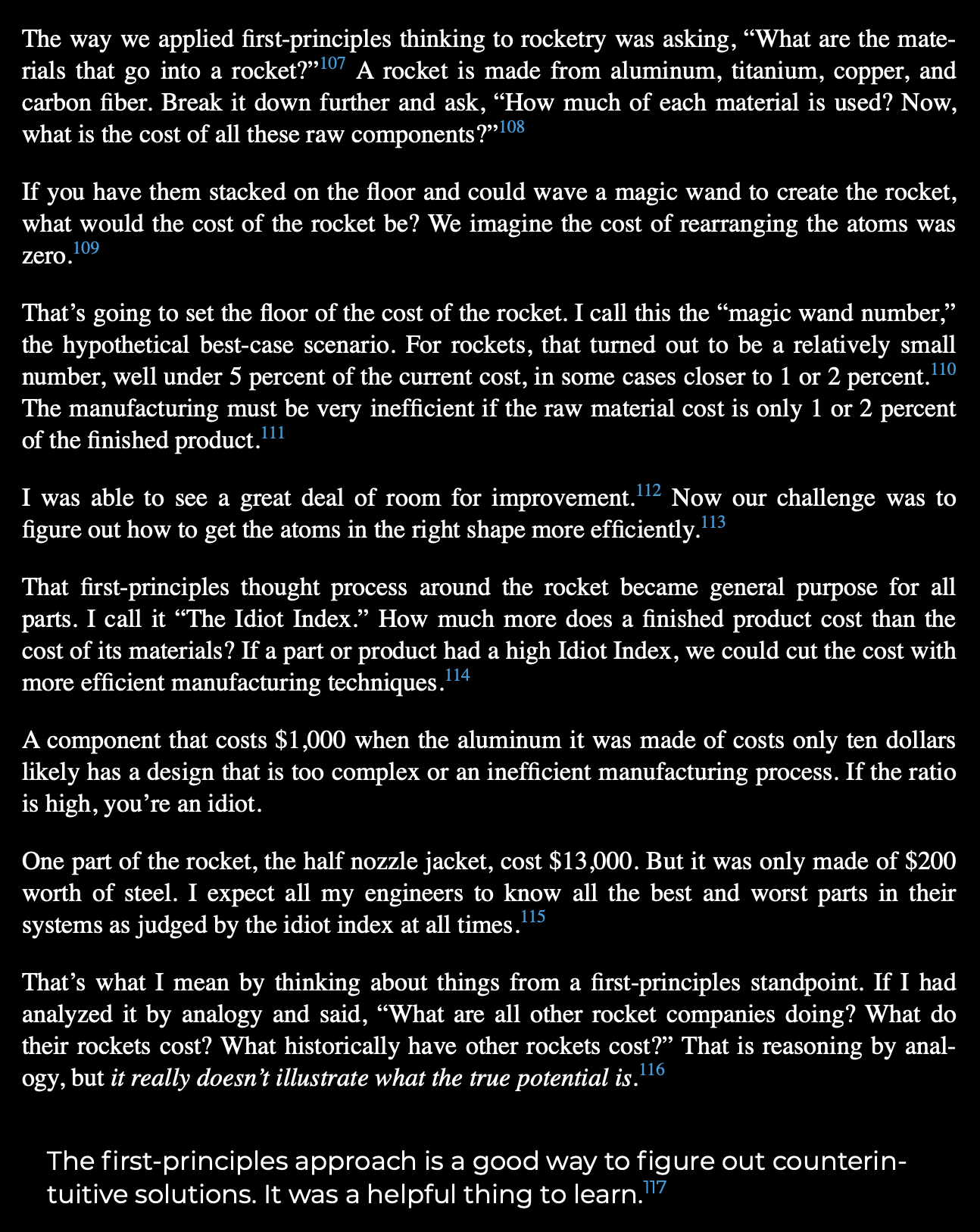
The way we applied first-principles thinking to rocketry was asking, "What are the materials that go into a rocket?" A rocket is made from aluminum, titanium, copper, and carbon fiber. Break it down further and ask, "How much of each material is used? Now, what is the cost of all these raw components?"
If you have them stacked on the floor and could wave a magic wand to create the rocket, what would the cost of the rocket be? We imagine the cost of rearranging the atoms was zero.
That's going to set the floor of the cost of the rocket. I call this the "magic wand number," the hypothetical best-case scenario. For rockets, that turned out to be a relatively small number, well under 5 percent of the current cost, in some cases closer to 1 or 2 percent. The manufacturing must be very inefficient if the raw material cost is only 1 or 2 percent of the finished product.
I was able to see a great deal of room for improvement. Now our challenge was to figure out how to get the atoms in the right shape more efficiently.
That first-principles thought process around the rocket became general purpose for all parts. I call it "The Idiot Index." How much more does a finished product cost than the cost of its materials? If a part or product had a high Idiot Index, we could cut the cost with more efficient manufacturing techniques.
A component that costs $1,000 when the aluminum it was made of costs only ten dollars likely has a design that is too complex or an inefficient manufacturing process. If the ratio is high, you're an idiot.
One part of the rocket, the half nozzle jacket, cost $13,000. But it was only made of $200 worth of steel. I expect all my engineers to know all the best and worst parts in their systems as judged by the idiot index at all times.
That's what I mean by thinking about things from a first-principles standpoint. If I had analyzed it by analogy and said, "What are all other rocket companies doing? What do their rockets cost? What historically have other rockets cost?" That is reasoning by analogy, but *it really doesn't illustrate what the true potential is.*
The first-principles approach is a good way to figure out counterintuitive solutions. It was a helpful thing to learn.
Saved attention and attributed commentary. The Research Library holds the separate source-supported research.