Hospice home health fraud Medicaid
Open original post on X · More from this plotline
Hospice and home health, both funded by borrowed federal money, are rampant with fraud. In Los Angeles, hospice agencies grew 1,500%, representing 18% of all hospice billing despite serving only 2.5% of the senior population. New York's Medicaid program allows patients to hire friends or family members, often with little to no healthcare experience, to provide "health services" and earn over $50,000 per year. If New York's per-resident Medicaid spending matched the U.S. average, the state would have spent $43 billion less in 2024. I commend @CMSGov and @VP's task force for identifying and suspending waste, fraud, and abuse in home health and hospice. The Biden administration let health care become a cash machine for fraudsters exploiting the vulnerable and robbing taxpayers. Every state should be rooting this out. When these schemes keep happening under the same Democratic governors, it stops looking accidental.
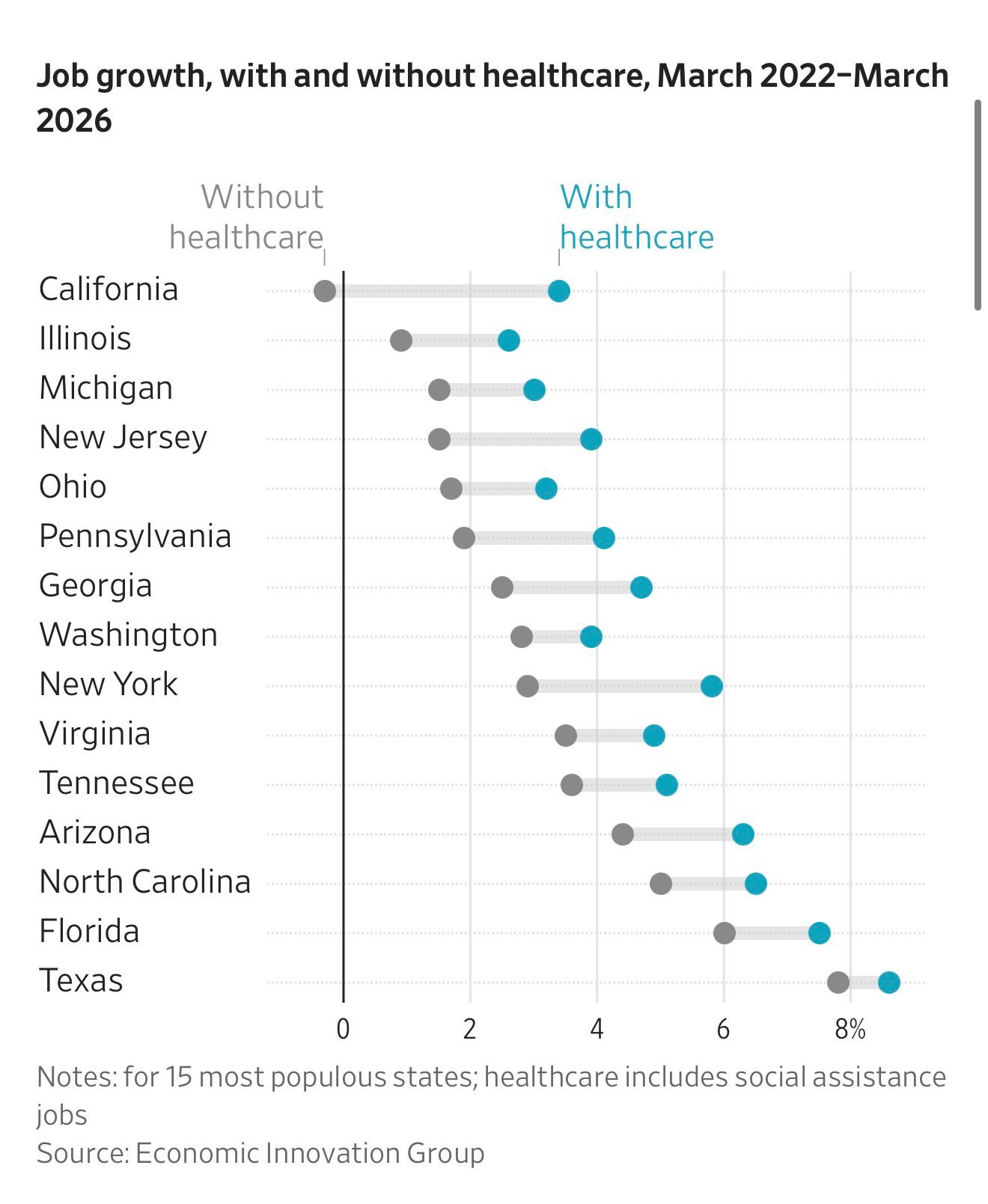
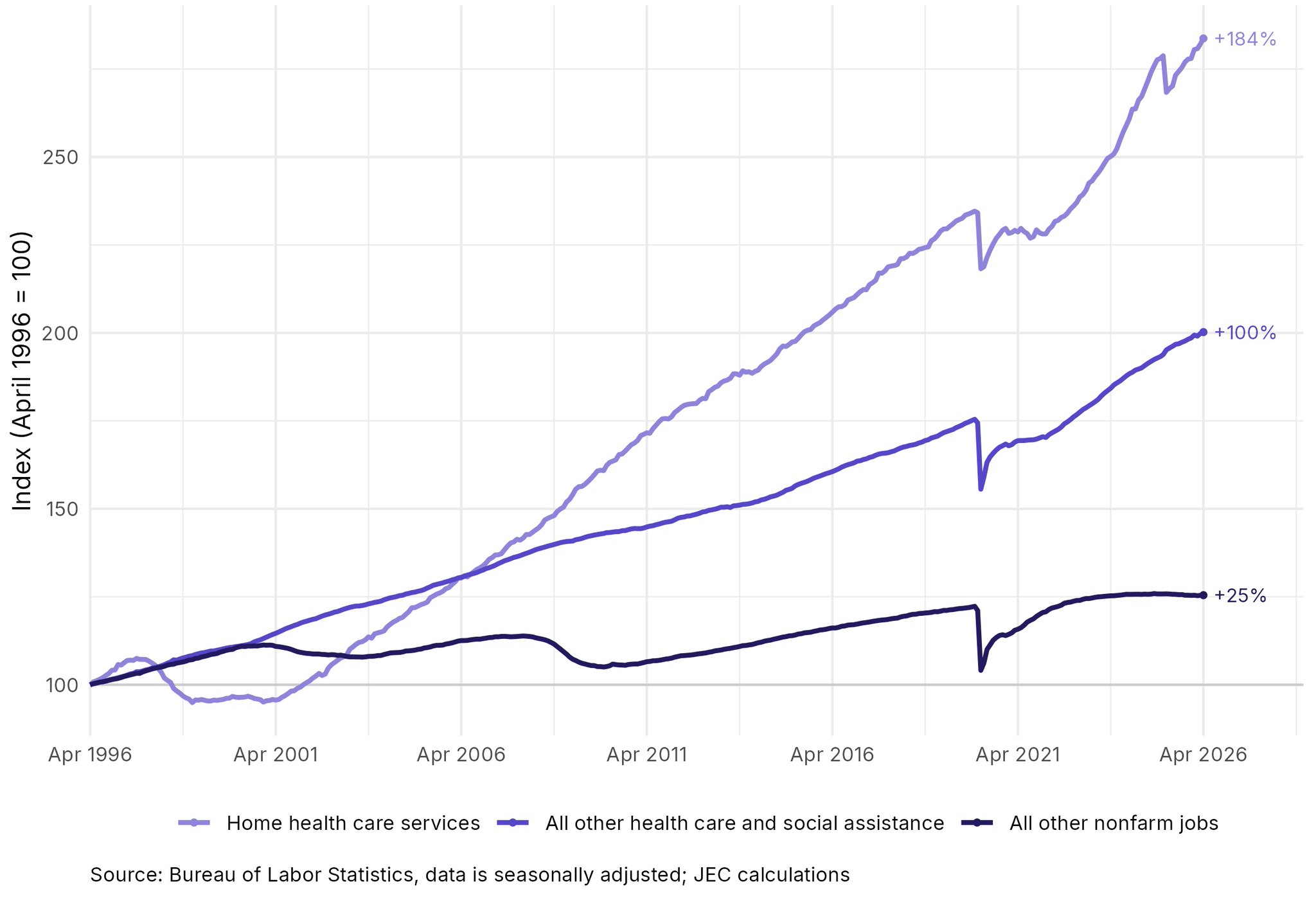
Text captured from the image
*(Transcribed from the attached screenshot.)*
Image 1 — A dumbbell chart titled "Job growth, with and without healthcare, March 2022–March 2026." Two markers per state: "Without healthcare" (grey) and "With healthcare" (teal). States listed top to bottom: California (without ≈ -0.3%, with ≈ 3.4%), Illinois, Michigan, New Jersey, Ohio, Pennsylvania, Georgia, Washington, New York (without ≈ 3%, with ≈ 5.8%), Virginia, Tennessee, Arizona, North Carolina, Florida, Texas (with ≈ 8.5%). X-axis 0 to ~8%. Notes: "for 15 most populous states; healthcare includes social assistance jobs. Source: Economic Innovation Group."
Image 2 — A line chart, "Index (April 1996 = 100)," X-axis Apr 1996 to Apr 2026. Three lines: "Home health care services" (light purple) ending "+184%"; "All other health care and social assistance" (purple) ending "+100%"; "All other nonfarm jobs" (dark navy) ending "+25%." A sharp dip is visible around 2020. Source line: "Bureau of Labor Statistics, data is seasonally adjusted; JEC calculations."
Saved attention and attributed commentary. The Research Library holds the separate source-supported research.