JAMA peer reviewers paid by Big Pharma
Open original post on X · More from this plotline
Captured references and cross-wing navigation · Saved media · Bounded complete reading
Peer-reviewed article about peer reviewers shows medical journals are bought and paid for by Big Pharma. In a new article published in JAMA, researchers found that half of the peer reviewers in medical journals received nearly a billion dollars in payments from industry. To be clear, JAMA is arguably the top peer-reviewed publication in the United States, and peer reviewers are the academic journal equivalent of fact-checkers. This means the science courts and our government rely on to decide cases and make public policy is about as reliable as the Washington Post. Now you know why there is so much “peer-reviewed science” claiming vaccines are safe and effective, glyphosate is not killing everyone, and mRNA is anything but deadly. @VigilantFox @RealAlexJones
Text captured from the image
*(Transcribed from the attached screenshot.)*
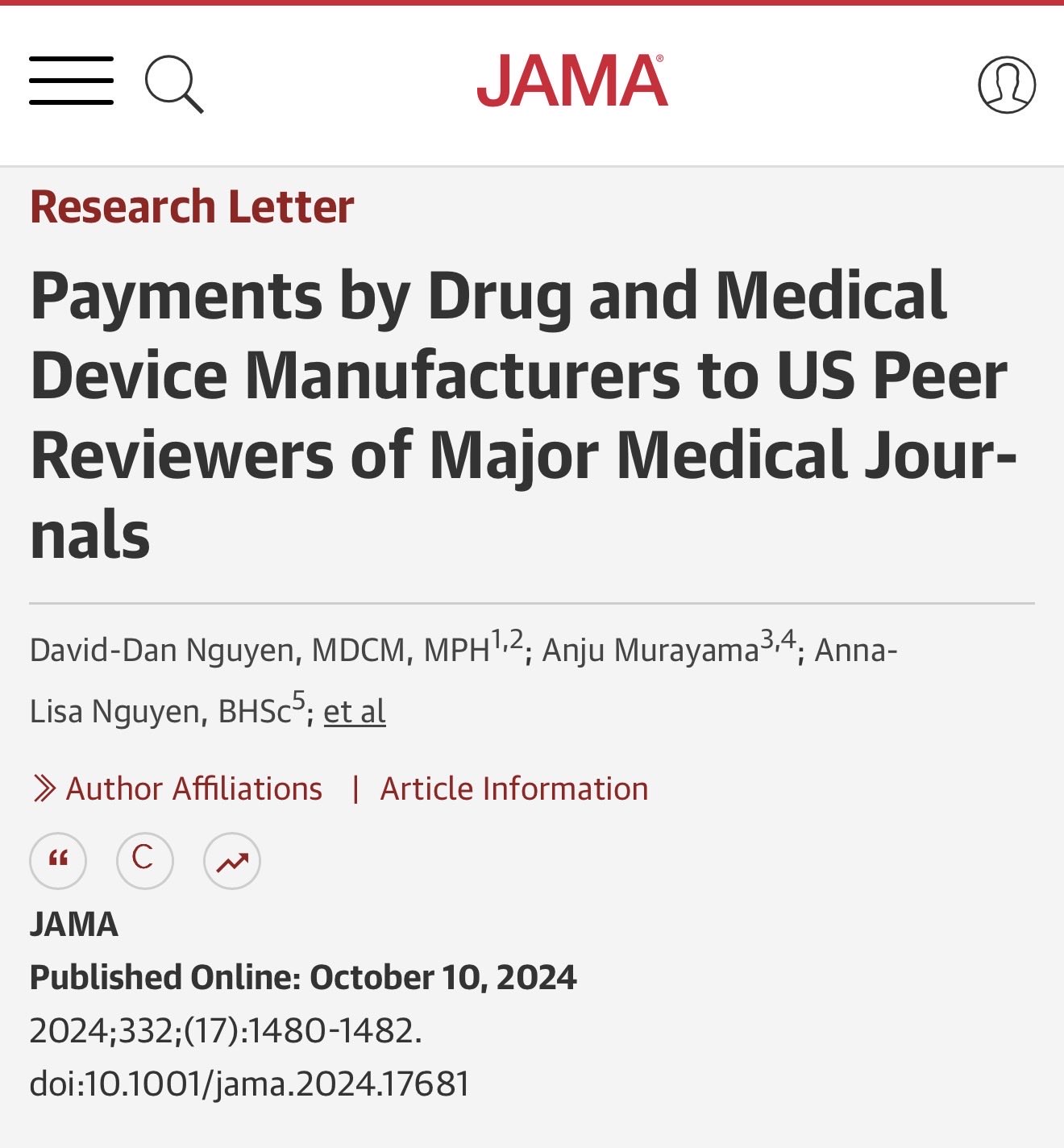
Image 1 — JAMA article header. "Research Letter — Payments by Drug and Medical Device Manufacturers to US Peer Reviewers of Major Medical Journals." Authors: David-Dan Nguyen, MDCM, MPH; Anju Murayama; Anna-Lisa Nguyen, BHSc; et al. "JAMA. Published Online: October 10, 2024. 2024;332;(17):1480-1482. doi:10.1001/jama.2024.17681."
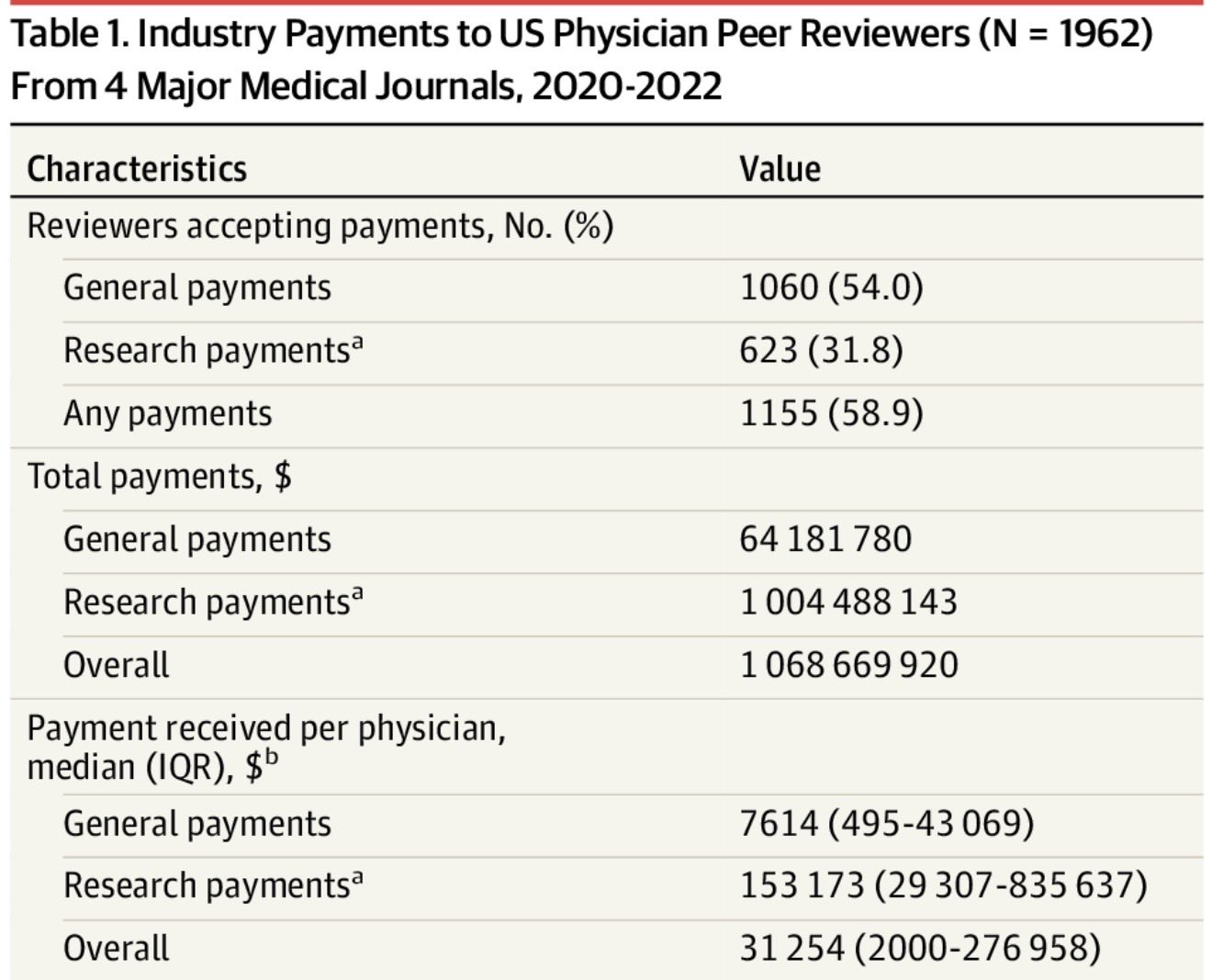
Image 2 — "Table 1. Industry Payments to US Physician Peer Reviewers (N = 1962) From 4 Major Medical Journals, 2020-2022." (Characteristics / Value)
Reviewers accepting payments, No. (%): General payments 1060 (54.0); Research payments 623 (31.8); Any payments 1155 (58.9).
Total payments, $: General payments 64,181,780; Research payments 1,004,488,143; Overall 1,068,669,920.
Payment received per physician, median (IQR), $: General payments 7614 (495-43,069); Research payments 153,173 (29,307-835,637); Overall 31,254 (2000-276,958).
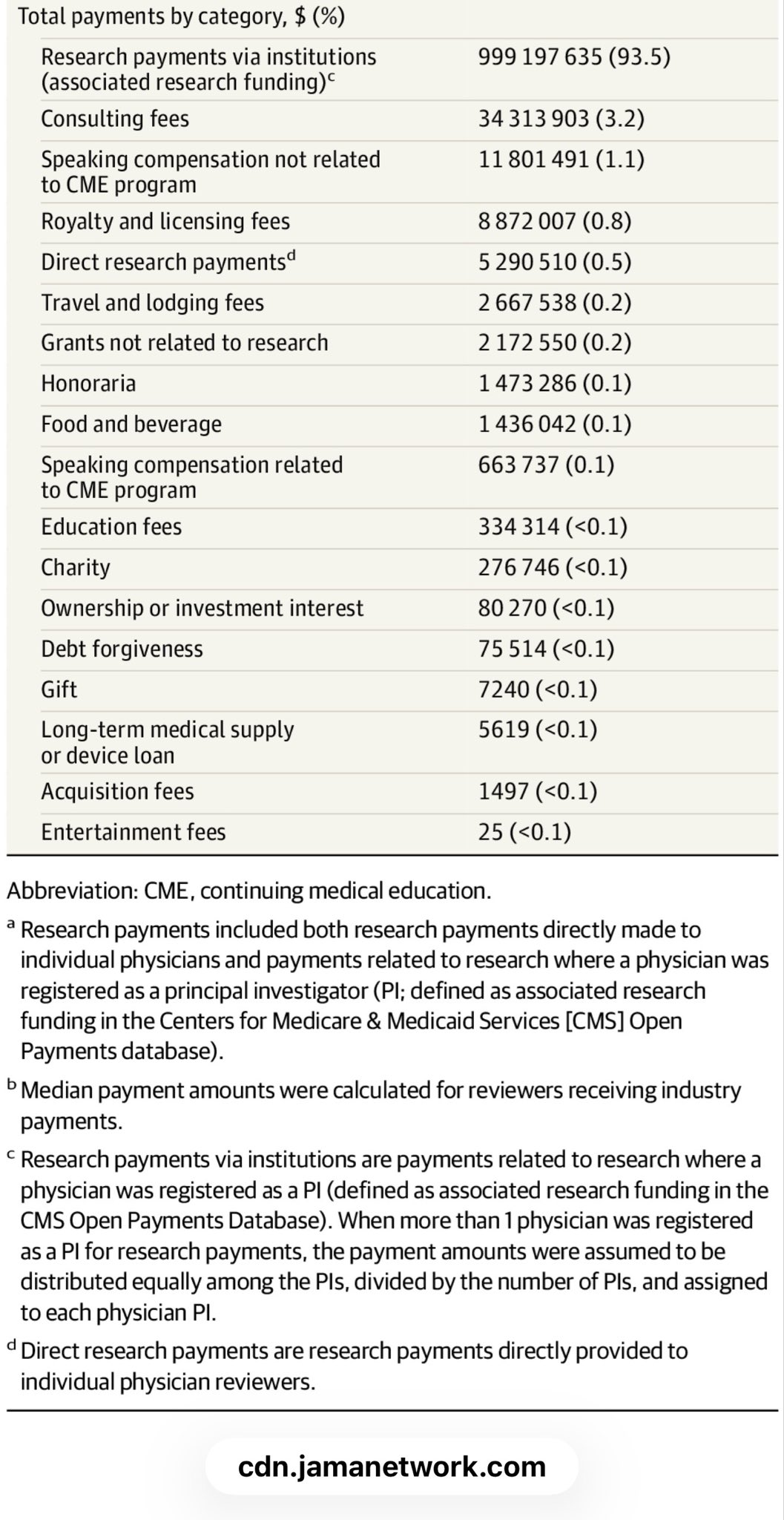
Image 3 — "Total payments by category, $ (%)": Research payments via institutions 999,197,635 (93.5); Consulting fees 34,313,903 (3.2); Speaking compensation not related to CME 11,801,491 (1.1); Royalty and licensing fees 8,872,007 (0.8); Direct research payments 5,290,510 (0.5); Travel and lodging fees 2,667,538 (0.2); Grants not related to research 2,172,550 (0.2); Honoraria 1,473,286 (0.1); Food and beverage 1,436,042 (0.1); Speaking compensation related to CME 663,737 (0.1); Education fees 334,314 (<0.1); Charity 276,746 (<0.1); Ownership or investment interest 80,270 (<0.1); Debt forgiveness 75,514 (<0.1); Gift 7240 (<0.1); Long-term medical supply or device loan 5619 (<0.1); Acquisition fees 1497 (<0.1); Entertainment fees 25 (<0.1). [Footnotes on CME, median calculation, institutional research payments, and direct research payments. Source: cdn.jamanetwork.com]
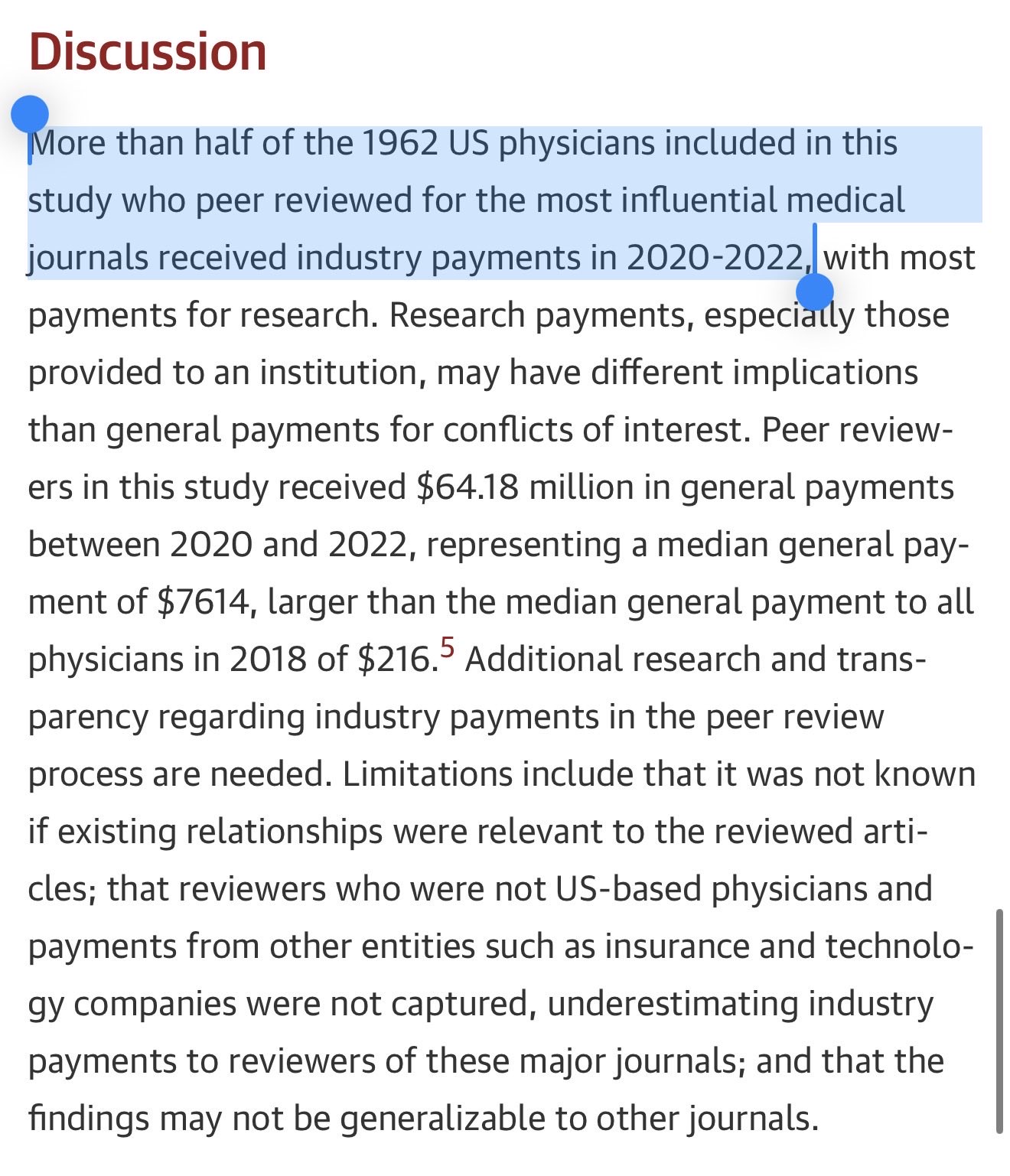
Image 4 — "Discussion" section (opening highlighted): "More than half of the 1962 US physicians included in this study who peer reviewed for the most influential medical journals received industry payments in 2020-2022, with most payments for research. Research payments, especially those provided to an institution, may have different implications than general payments for conflicts of interest. Peer reviewers in this study received $64.18 million in general payments between 2020 and 2022, representing a median general payment of $7614, larger than the median general payment to all physicians in 2018 of $216. Additional research and transparency regarding industry payments in the peer review process are needed. Limitations include that it was not known if existing relationships were relevant to the reviewed articles; that reviewers who were not US-based physicians and payments from other entities such as insurance and technology companies were not captured, underestimating industry payments to reviewers of these major journals; and that the findings may not be generalizable to other journals."
Saved attention and attributed commentary. The Research Library holds the separate source-supported research.