Skip to content
The SkyFreedom 250 Observatory
Colour theme
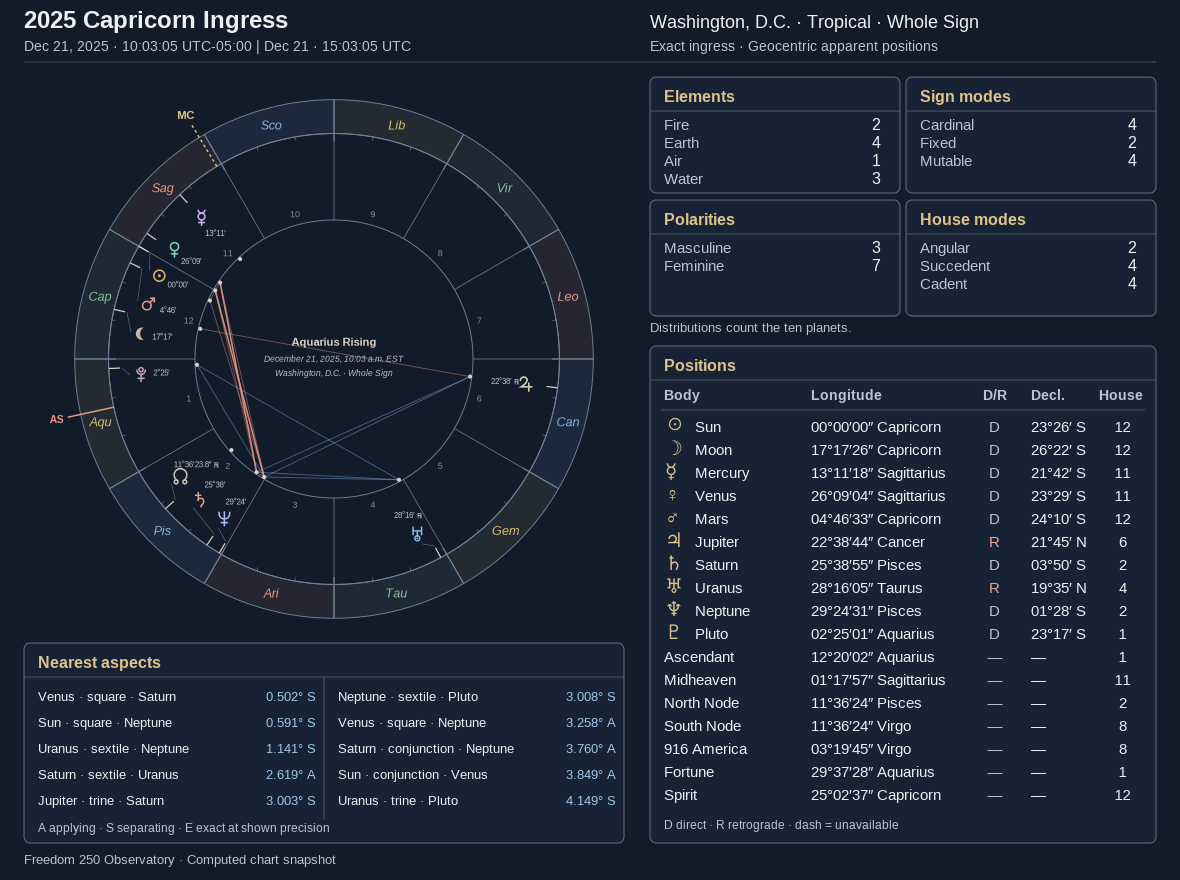
View annotations and tables Exact chart · Washington, D.C. · Whole Sign

The Sky · Seasons & readings · Nested cardinal stage

2025 Capricorn Ingress

December 21, 2025 to March 20, 2026

Read the complete ingress reading

Answer first

This is a winter of concentrated power working behind the visible surface: the nation is asked to decide what it will fund, protect, and discipline while much of the action remains difficult to see clearly. The chart does not describe a loose or improvisational season. Aquarius rises in a fixed sign, and its ruler, Saturn, stands in the 2nd house of the treasury. The season holds its line. What changes is the definition of security itself.

Read the complete ingress reading
AmendedFactual correction dated September 25, 2026. The reading is sealed and unchanged; the correction sits beside it.Show the correction

DR-082 · September 25, 2026

A factual correction to the computed bones, not a rewrite of the hearing. The engine's detriment table kept only one detriment sign per planet, so these bones listed Mercury without its essential debility. Corrected: Mercury at 13°11′ Sagittarius is in detriment. The hearing never describes it as dignified or peregrine, so no sentence is withdrawn; read Mercury's tools as those of a planet in detriment.

Complete authored reading

This is a winter of concentrated power working behind the visible surface: the nation is asked to decide what it will fund, protect, and discipline while much of the action remains difficult to see clearly. The chart does not describe a loose or improvisational season. Aquarius rises in a fixed sign, and its ruler, Saturn, stands in the 2nd house of the treasury. The season holds its line. What changes is the definition of security itself.

Saturn does not govern alone. It belongs to a closed circuit with exalted Jupiter and the Moon: Saturn answers to Jupiter, Jupiter answers to the Moon, and the Moon returns to Saturn. Money, labor, protection, and the condition of the public therefore cannot be separated. Saturn in the 2nd demands limits and durable accounting. Jupiter, exalted but retrograde in the 6th, wants to enlarge protection through workers, public systems, health, and the armed services, yet it does so by reviewing, restoring, or returning to unfinished obligations. The Moon in detriment in the 12th shows the public and political class carrying pressure that is real but partially concealed. Each member of the circuit needs the other two; none can deliver the season by itself.

The 12th house is unusually full. The Sun enters Capricorn there, joined by an exalted but combust Mars and accompanied by the Moon. Executive purpose, force, and public feeling gather in a place associated with confinement, secrecy, hidden opposition, and what institutions would prefer not to display. At the constructive pole, this can be disciplined work conducted away from spectacle: preparation, enforcement, containment, or the repair of systems whose failures have been hidden. At the destructive pole, it can become force without sufficient visibility, a political class trapped inside its own defenses, or action justified before the public can see its full cost.

The treasury is equally charged. Saturn applies to Neptune in Pisces while the Sun and Venus both square Neptune. The season presses hard on the boundary between a real resource and a promised one, a measured obligation and an idealized claim. Saturn can give Neptune form; Neptune can soften rules that have become lifeless. But their unfinished conjunction can also make the accounting permeable. Venus in the legislature-and-allies house squares both Saturn and Neptune, so agreements about value encounter the conflict directly. The danger is not merely scarcity. It is allowing desire, loyalty, or vision to stand in for an auditable commitment.

There is substantial competence in the chart. Mars is exalted. Jupiter is exalted. Jupiter and Saturn remain in a trine, and Saturn applies by sextile to Uranus in the 4th. A strong institutional response can connect protection and restraint, or join old financial rules to changes in land, infrastructure, and the national foundation. Yet strength does not guarantee wisdom. Exalted Mars is combust and hidden; exalted Jupiter is retrograde. Capability may be intense while its mandate, timing, or visibility is compromised. The useful question is whether power is being brought under a trustworthy structure or merely becoming more effective at operating out of sight.

Pluto in the 1st makes the national body the site of the deeper transformation. The country cannot treat money, service, and hidden power as remote technical matters; they alter how it understands itself. The chart can describe a period of sober renewal in which concealed liabilities are faced and public systems are fortified. It can also describe a fixed defensive posture that turns every uncertainty into a reason for greater control. The better expression does not deny danger. It makes the terms of protection visible enough that the public can recognize what is being done in its name.

Timing and relationships

  • The ingress is exact on December 21, 2025 at 15:03:05 UTC / 10:03:05 EST and governs the Capricorn seasonal layer.
  • The opening December 20 Sagittarius New Moon closely squares ingress Neptune and conjoins the ingress Sun, immediately activating the tension between hidden purpose and financial definition.
  • The January 3 and February 1 Full Moons, and the January 18 New Moon, make no close major contact to an ingress planet. They develop the climate without repeating its exact circuitry.
  • The February 17 solar eclipse squares ingress Uranus within 0.561°. The March 3 lunar eclipse squares ingress Mercury within 0.290°. The March 19 New Moon returns directly to ingress Saturn, Neptune, the Sun, and Venus.
  • The United States remains in its age-249, 10th-house Virgo profection, ruled by Mercury, until July 2.

Technical proof

  • Chart: Washington, D.C.; day chart; 12°20′ Aquarius rising; 1°18′ Sagittarius MC; fixed Ascendant; locomotive distribution across 219.46°.
  • Root: Saturn–Jupiter–Moon closed loop. Saturn 25°39′ Pisces in the 2nd; Jupiter 22°39′ Cancer retrograde, exalted, in the 6th; Moon 17°17′ Capricorn, in detriment, in the 12th.
  • Concentration: Sun 0°00′ Capricorn, Moon 17°17′ Capricorn, and Mars 4°47′ Capricorn in the 12th. Mercury 13°11′ Sagittarius and Venus 26°09′ Sagittarius in the 11th. Pluto 2°25′ Aquarius in the 1st.
  • Key longitude aspects: Venus square Saturn 0.502° separating; Sun square Neptune 0.591° separating; Saturn sextile Uranus 2.619° applying; Jupiter trine Saturn 3.003° separating; Venus square Neptune 3.258° applying; Saturn conjunct Neptune 3.760° applying; Sun conjunct Mars 4.776° applying; Moon opposite Jupiter 5.355° applying.
  • Declination: Sun parallel Venus 0.046° and Pluto 0.153°; Mercury contra-parallel Jupiter 0.047°; Venus parallel Mars 0.690° and Pluto 0.199°.
  • United States contacts, rectified Sagittarius chart: ingress Neptune opposite U.S. MC 0.502°; Sun opposite U.S. Venus 0.655°; Mars opposite U.S. Jupiter 0.705°; nodal axis square U.S. Ascendant 0.881°.

Season spine

Follow the ingress, its lunar chapters and any nested cardinal stages.

2025 Aries Ingress governs until March 20, 2026
Reading coverage · Dec 21 to Mar 18
December 21, 2025March 20, 2026

Opening lunar chapter · Sagittarius New Moon · Washington: December 19, 2025 · UTC: December 20, 2025

  1. December 21, 2025 · Nested stage

    2025 Capricorn Ingress

    Reading availableAmended

    Read the ingress
  2. Washington: December 19, 2025 · UTC: December 20, 2025 · New Moon

    Sagittarius New Moon

    Retrospective calibration. Written 2026-09-25 from the computed chart alone, after the window closed. It carries no forecast credit; the record and the comparison…

    Reading available

    Preview inside the season
  3. January 3, 2026 · Full Moon

    Cancer Full Moon

    This Full Moon makes the nation look directly at the bond between what it owns and what it owes: the public need for protection confronts a tightly concentrated…

    Reading available

    Preview inside the season
  4. January 18, 2026 · New Moon

    Capricorn New Moon

    This New Moon compresses power into the terms of debt, pooled resources, and financial obligation, asking whether concentration will be used to stabilize a system…

    Reading available

    Preview inside the season
  5. February 1, 2026 · Full Moon

    Leo Full Moon

    This Full Moon makes the national body unmistakably visible while placing it across from a powerful concentration of allies, opponents, agreements, and collective…

    Reading available

    Preview inside the season
  6. February 17, 2026 · Solar Eclipse

    Aquarius Solar Eclipse

    This eclipse places a break in continuity directly on the national body: identity, public direction, and the country's sense of its own future are reset under…

    Reading available

    Preview inside the season
  7. March 3, 2026 · Lunar Eclipse

    Virgo Lunar Eclipse

    This eclipse reveals the truth of a relationship: the nation can no longer understand itself only through its own story, because the other party, the treaty, the…

    Reading available

    Preview inside the season
  8. Washington: March 18, 2026 · UTC: March 19, 2026 · New Moon

    Pisces New Moon

    This final winter seed gathers unresolved questions of money, duty, and hidden purpose into the daily work of the nation, then hands them toward a new public…

    Reading availableAmended

    Preview inside the season

Chapter preview

Governing ingress2025 Aries IngressShowing

Sagittarius New Moon

Washington: December 19, 2025 · UTC: December 20, 2025

Enlarge the chart Exact chart · Washington, D.C. · Whole Sign
Exact Washington clock
December 19, 2025, 8:43 p.m. EST
Rising
18°06′47.8″ Leo
Role
New Moon
Root
Moon · Jupiter
Governing ingress
2025 Aries Ingress

No amendment This reading has no correction.

Complete authored reading

> Retrospective calibration. Written 2026-09-25 from the computed chart alone, after the window closed. It carries no forecast credit; the record and the comparison live in separate files (DR-063).

The year's last New Moon seeds its cycle in the house of markets and speculation, at the final degree of Sagittarius. It strikes the Aries year's Sun–Neptune point and the Libra chart's Saturn almost to the minute, and it is the hand-off chart into the winter solstice.

The Sun and Moon meet at 28°25′ Sagittarius in the 5th, joined by Venus at 24°12′ and Mercury in detriment at 10°57′. Leo rises and the Sun rules, so the chart ruler is the New Moon itself, on the last degree of the sign of principle, two days before the solstice. The 5th is the house of speculation, markets, national pleasure and children. The seed is a new cycle of confidence and appetite: what the nation is willing to wager, celebrate or believe about its future. It is begun at a threshold, the last word of one sign before the institutional sign begins.

The lights square Neptune at 29°24′ Pisces in the 8th within 0.98° and Saturn at 25°35′ within 2.83°, and Venus squares Saturn within 1.39°. The optimism of the 5th meets the Saturn–Neptune pair in the house of debt, shared finance and foreign money. What is being wagered is tested against what is owed. The root is a mutual reception between the Moon and Jupiter: the Moon in Sagittarius, Jupiter's sign, and Jupiter exalted and retrograde at 22°49′ Cancer in the 12th. The public mood in the markets and a strong benefic in the hidden house rule each other. Confidence is underwritten from out of view.

Mars, newly exalted at 3°36′ Capricorn in the 6th and combust, gives the working body of the state and the armed services disciplined force. Pluto sits at 2°22′ Aquarius in the 7th, in the house of the counterpart. The chart does not lack strength. Its tension lies between the speculative seed and the obligations it must answer to.

This New Moon is the hand-off between frames. Its lights square the governing Aries ingress Neptune in the 2nd within 1.20° and its exalted Sun within 1.58°, the year's defining Sun–Neptune point, struck here a second time after the September eclipse opposed it. It also squares the nested Libra ingress Saturn within 0.03° and conjoins that chart's Ascendant within 0.83°. Two days later the Capricorn ingress takes up the winter. The U.S. chart receives Mercury conjunct the U.S. Ascendant within 0.23° and the lights square U.S. MC within 0.49°. The constructive pole is a new cycle of national confidence that accepts its debts honestly. The shadow is a wager made at the threshold, on credit held in the hidden house, against a fog the year never cleared.

Timing and relationships

  • New Moon is exact December 19, 2025 at 8:43:21 PM EST (01:43:21 UTC).
  • Inside this chapter (to the next lunation): Dec 24 — Venus enters Capricorn.

Technical proof

  • Chart: Washington, D.C.; night chart; 18°07′ Leo rising (fixed); MC 10°07′ Taurus in the 10th; Whole Sign; chart ruler Sun.
  • Lights: Sun and Moon conjunct — Sun 28°25′ Sagittarius in the 5th; Moon 28°25′ Sagittarius in the 5th, combust, cazimi.
  • Root: closed loop Jupiter → Moon → Jupiter.
  • Root members: Moon 28°25′ Sagittarius in the 5th, combust, cazimi; Jupiter 22°49′ Cancer retrograde in the 12th, exalted.
  • Other placements: Mercury 10°57′ Sagittarius in the 5th, detriment; Venus 24°12′ Sagittarius in the 5th, combust; Mars 3°36′ Capricorn in the 6th, exalted, combust; Saturn 25°35′ Pisces in the 8th; Uranus 28°19′ Taurus retrograde in the 10th; Neptune 29°24′ Pisces in the 8th; Pluto 2°22′ Aquarius in the 7th.
  • Nodes and lots: North Node 11°56′ Pisces in the 8th; Fortune 18°07′ Leo in the 1st.
  • America (916): 3°18′ Virgo in the 2nd.
  • Key longitude aspects: Sun square Neptune 0.984° applying; Moon square Neptune 0.984° applying; Uranus sextile Neptune 1.078° separating; Venus square Saturn 1.393° applying; Saturn sextile Uranus 2.735° applying; Jupiter trine Saturn 2.762° separating; Sun square Saturn 2.830° separating; Moon square Saturn 2.830° separating.
  • Declination: Venus parallel Pluto 0.056°; Sun parallel Venus 0.079°; Sun parallel Pluto 0.134°; Mercury contra-parallel Jupiter 0.507°.
  • Greer comparison to the governing 2025 Aries ingress: lights square 2025 Aries ingress Neptune (2nd) 1.202°; lights square 2025 Aries ingress Sun (3rd) 1.584°.
  • Nested 2025 Libra ingress: square Saturn (4th) 0.025°; square Sun (11th) 1.584°; square Neptune (5th) 2.363°.
  • U.S. locked chart (July 2, 1776, Sagittarius rising): Mercury conjunction U.S. ASC 0.226°; Sun square U.S. MC 0.491°; Moon square U.S. MC 0.491°; Neptune opposition U.S. MC 0.492°.
  • Calculation: Swiss Ephemeris files (JPL DE441-based sepl_18/semo_18), 99 - Templates/ephe; exact syzygy solved to sub-second; D.C. 38.9072° N, 77.0369° W. Cast 2026-09-25.
Technical proof

2025-12-20T01:43:21.022974+00:00 UTC · Washington, D.C. · Whole Sign

BodyLongitudeHouse
Sun28°24′56.6″ Sagittarius5
Moon28°24′56.6″ Sagittarius5
Mercury10°57′04.7″ Sagittarius5
Venus24°11′35.2″ Sagittarius5
Mars3°35′45.6″ Capricorn6
Jupiter22°49′25.3″ Cancer12
Saturn25°35′10.2″ Pisces8
Uranus28°19′15.4″ Taurus10
Neptune29°23′57.4″ Pisces8
Pluto2°22′25.4″ Aquarius7

Frozen baseline baseline-2025-libra-v1 · bc3a3418179f33cdcb424dc9b6a40af431536b1824f41a73c52892f08d6a859a

Chart JSON · Reading JSON

Cancer Full Moon

January 3, 2026

Enlarge the chart Exact chart · Washington, D.C. · Whole Sign
Exact Washington clock
January 3, 2026, 5:02 a.m. EST
Rising
9°30′06.6″ Sagittarius
Role
Full Moon
Root
Moon
Governing ingress
2025 Aries Ingress

No amendment This reading has no correction.

Complete authored reading

This Full Moon makes the nation look directly at the bond between what it owns and what it owes: the public need for protection confronts a tightly concentrated financial will. The Moon is at home in Cancer in the 8th house, exactly opposite the Capricorn Sun in the 2nd. It is not a weak or distant public presence. It is the chart's sole final dispositor, and every planetary chain eventually arrives there. Shared resources, debt, dependency, loss, and the terms on which support is given become the place where the chart must tell the truth.

The 2nd house answers with unusual force. The Sun is joined by combust Venus and an exalted, combust Mars; Mercury is there as well. This is a determined effort to define value, direct resources, and act on material priorities. Mars can cut through delay and make a financial decision effective. Venus can name what is worth preserving. Yet both are hidden in the Sun's glare, so urgency can outrun consent and value can be reduced to whatever executive purpose can absorb. Opposite them, the Cancer Moon insists that an account is incomplete if it ignores vulnerability, obligation, or the people carrying the consequence.

Exalted Jupiter, retrograde in the 8th, enlarges the Moon's side of the axis. There can be genuine abundance in a return to mutual aid, recovered resources, or protections that had been neglected. There can also be overextension through debt, rescue, or the belief that support has no limit. Because Jupiter is retrograde, the Full Moon leans toward reassessment rather than simple expansion. The most constructive outcome is not generosity versus restraint. It is a fuller reckoning in which protection is made sustainable and the price of action is admitted.

The national foundation remains unsettled beneath that reckoning. Saturn and Neptune are conjunct in the 4th, Mercury squares Neptune, and Saturn applies by sextile to Uranus in the 6th. Old assumptions about land, security, and belonging are dissolving while work systems and public services press for change. A practical redesign is possible, but only if language stays precise. Mercury's square to Neptune warns that figures, promises, and explanations can blur at the moment they most need definition.

The chart therefore holds two real possibilities. One is a mature confrontation with interdependence: public need becomes visible, hidden costs enter the ledger, and concentrated authority accepts limits. The other is a struggle in which each side claims the whole moral field—control speaking as prudence, dependency speaking as entitlement—while the underlying obligation grows. The Moon's strength favors recognition. What remains open is whether recognition becomes care with structure or fear with a larger budget.

Timing and relationships

  • The Full Moon is exact January 3, 2026 at 10:02:54 UTC / 5:02:54 EST.
  • It culminates the December 20 Sagittarius New Moon at 28.4° Sagittarius.
  • It makes no close major contact to a planet in the Capricorn ingress, so it reveals the season through its own 2nd/8th-house axis rather than by repeating an ingress aspect.
  • Jupiter's placement on Pluto's north planetary node within 0.154° intensifies the 8th-house question of expansion, debt, and shared power.
  • In the U.S. rectified chart, the lunation's nodal axis squares the U.S. Ascendant within 0.145°, and Mars squares U.S. Saturn within 0.205°.

Technical proof

  • Chart: Washington, D.C.; night chart; 9°30′ Sagittarius rising; 26°27′ Virgo MC; locomotive distribution across 198.68°.
  • Lights and root: Sun 13°02′ Capricorn in the 2nd opposite Moon 13°02′ Cancer in the 8th, exact. Moon is domiciled and is the sole final dispositor.
  • Financial axis: Venus 12°15′ Capricorn and exalted Mars 14°33′ Capricorn are combust in the 2nd; Jupiter 21°02′ Cancer is exalted, retrograde, and in the 8th.
  • Key longitude aspects: Sun conjunct Venus 0.783° applying; Moon opposite Venus 0.783° separating; Sun conjunct Mars 1.511° applying; Moon opposite Mars 1.511° applying; Saturn sextile Uranus 1.572° applying; Venus conjunct Mars 2.294° applying; Mercury square Neptune 2.820° separating; Saturn conjunct Neptune 3.226° applying.
  • Declination: Venus parallel Mars 0.080° and Pluto 0.261°; Mars parallel Pluto 0.341°; Sun parallel Pluto 0.405°.
  • United States contacts: nodal axis square U.S. Ascendant 0.145°; Mars square U.S. Saturn 0.205°; Neptune opposite U.S. MC 0.632°; Venus opposite U.S. Sun 0.833°.
Technical proof for this chart

Washington January 3, 2026 · 5:02:54 AM UTC-05:00
Universal time January 3, 2026 · 10:02:54 AM UTC

BodyLongitudeWhole Sign houseSpeed (°/day)Declination (°)Conditions
Jupiter21°02′21.8″ Cancer8-0.13249+22.03430exalted
Mars14°32′37.3″ Capricorn2+0.76796-23.54521exalted, combust
Mercury2°21′30.3″ Capricorn2+1.53973-24.24532peregrine
Moon13°01′58.4″ Cancer8+14.88247+27.06163domicile
Neptune29°32′18.6″ Pisces4+0.01378-1.40460peregrine
Pluto2°47′31.7″ Aquarius3+0.03054-23.20443peregrine
Saturn26°18′46.1″ Pisces4+0.06203-3.53135peregrine
Sun13°01′58.4″ Capricorn2+1.01885-22.79966peregrine
Uranus27°53′05.7″ Taurus6-0.02580+19.49588peregrine
Venus12°14′59.2″ Capricorn2+1.25819-23.46554combust

Longitude labels truncate at the displayed precision. Calculations use the full longitude.

Governing ingress

Chart pointContactReference pointOrbType
NeptuneconjunctNeptune0.0789°Body or point
NeptuneconjunctSun0.4615°Body or point
PlutoconjunctPluto0.5529°Body or point
JupiterconjunctMars0.7898°Body or point
UranusoppositeMC0.8319°Angle contact
MCoppositeNode0.9396°Angle contact
SaturnconjunctNode1.0720°Body or point
MercurysquareVenus1.9659°Body or point
MercurysquareSun2.3584°Body or point
MercurysquareNeptune2.7410°Body or point

U.S. founding chart

Chart pointContactReference pointOrbType
NodesquareASC0.1446°Angle contact
MarssquareSaturn0.2049°Body or point
NeptuneoppositeMC0.6316°Angle contact
ASCoppositeUranus0.6829°Angle contact
VenusoppositeSun0.8330°Body or point
NeptunesquareVenus1.1168°Body or point

The authored edition preserves its historical technical statements. Read them with the dated corrections. Authored edition and amendments

Capricorn New Moon

January 18, 2026

Enlarge the chart Exact chart · Washington, D.C. · Whole Sign
Exact Washington clock
January 18, 2026, 2:51 p.m. EST
Rising
29°42′08.1″ Gemini
Role
New Moon
Root
Jupiter · Moon · Saturn
Governing ingress
2025 Aries Ingress

No amendment This reading has no correction.

Complete authored reading

This New Moon compresses power into the terms of debt, pooled resources, and financial obligation, asking whether concentration will be used to stabilize a system or to make its leverage harder to contest. The Sun and Moon meet at 28°44′ Capricorn in the 8th house with Mercury and exalted Mars close beside them. Nothing about this seed is casual. It wants a binding decision, a durable arrangement, and a structure capable of surviving pressure.

The Moon is in detriment, but it is also at the heart of the Sun. Public feeling may have little room to move independently, yet it is not absent; it is drawn into the central purpose. Mercury is combust and Mars is both exalted and combust. Thought, negotiation, and enforcement operate at high intensity but with reduced visibility. The constructive pole is disciplined resolution: liabilities can be named, terms tightened, and shared resources organized around a coherent obligation. The shadow is equally clear: a settlement can become coercive when the same concentration that makes action possible also conceals who set the terms.

The chart's root is the same Saturn–Jupiter–Moon circuit that governs the Capricorn ingress, now distributed across the 10th, 2nd, and 8th houses. Saturn in the 10th places responsibility with government and executive administration. Exalted Jupiter, retrograde in the 2nd, revisits what the treasury can sustain. The Moon carries the result into debt and other people's money before returning it to Saturn. This is not a simple contest between government and finance. Each is bound to the public consequences of the other.

A remarkably close earth-and-water network gives the New Moon practical reach. Saturn sextiles Uranus within 0.136°. Mercury joins Mars within 0.444°, sextiles Saturn within 0.543°, and trines Uranus within 0.679°. Mars also sextiles Saturn and trines Uranus. A complicated arrangement can be engineered, revised, or modernized with unusual speed. Yet Neptune stands with Saturn in the 10th, and Pluto joins Venus in the 9th. The governing story may carry visionary conviction or ideological pressure beyond what the material terms alone justify.

Both outcomes live inside the same concentrated chart. It can seed a serious restructuring that protects the whole by clarifying responsibility. It can also seed a compact so internally coherent that objections are treated as defects rather than information. The measure of the New Moon is not whether it produces decisive terms. It is whether those terms remain legible to the people whose security and obligations are being rearranged.

Timing and relationships

  • The New Moon is exact January 18, 2026 at 19:51:59 UTC / 2:51:59 EST.
  • It falls in the Eclipse Storm family band but is not itself an eclipse.
  • It makes no close major contact to an ingress planet; its connection to the seasonal climate is the repeated Saturn–Jupiter–Moon root.
  • In the U.S. rectified chart, the Sun and Moon conjoin the U.S. Moon within 0.398°, Mercury conjoins U.S. Pluto within 0.700°, and the chart's America point squares the U.S. MC within 0.109°.
  • The U.S. remains in its age-249, 10th-house Virgo profection ruled by Mercury.

Technical proof

  • Chart: Washington, D.C.; day chart; 29°42′ Gemini rising; 7°30′ Pisces MC; bowl distribution across 172.52°.
  • Seed: Sun and Moon 28°44′ Capricorn in the 8th. Moon is in detriment, combust, and cazimi.
  • Concentration: Mercury 26°54′ Capricorn, exalted Mars 26°27′ Capricorn, and the lights occupy the 8th; Jupiter 18°59′ Cancer is exalted and retrograde in the 2nd; Saturn 27°26′ Pisces and Neptune 29°49′ Pisces occupy the 10th.
  • Root: Saturn–Jupiter–Moon closed loop; no sole final dispositor.
  • Key longitude aspects: Saturn sextile Uranus 0.136° applying; Mercury conjunct Mars 0.444° separating; Mercury sextile Saturn 0.543° applying; Mercury trine Uranus 0.679° applying; Mars sextile Saturn 0.987° applying; Sun and Moon sextile Neptune 1.081° applying; Sun and Moon trine Uranus 1.157° separating; Saturn conjunct Neptune 2.375° applying.
  • Declination: Mercury contra-parallel Jupiter 0.337°; Mercury parallel Pluto 0.396°; Sun parallel Venus 0.442°; Mars contra-parallel Jupiter 0.539°.
Later registered version

2026-01-18 Capricorn New Moon — A Reading

This New Moon compresses power into the terms of debt, pooled resources, and financial obligation, asking whether concentration will be used to stabilize a system or to make its leverage harder to contest. The Sun and Moon meet at 28°44′ Capricorn in the 8th house with Mercury and exalted Mars close beside them. Nothing about this seed is casual. It wants a binding decision, a durable arrangement, and a structure capable of surviving pressure.

The Moon is in detriment, but it is also at the heart of the Sun. Public feeling may have little room to move independently, yet it is not absent; it is drawn into the central purpose. Mercury is combust and Mars is both exalted and combust. Thought, negotiation, and enforcement operate at high intensity but with reduced visibility. The constructive pole is disciplined resolution: liabilities can be named, terms tightened, and shared resources organized around a coherent obligation. The shadow is equally clear: a settlement can become coercive when the same concentration that makes action possible also conceals who set the terms.

The chart's root is the same Saturn–Jupiter–Moon circuit that governs the Capricorn ingress, now distributed across the 10th, 2nd, and 8th houses. Saturn in the 10th places responsibility with government and executive administration. Exalted Jupiter, retrograde in the 2nd, revisits what the treasury can sustain. The Moon carries the result into debt and other people's money before returning it to Saturn. This is not a simple contest between government and finance. Each is bound to the public consequences of the other.

A remarkably close earth-and-water network gives the New Moon practical reach. Saturn sextiles Uranus within 0.136°. Mercury joins Mars within 0.444°, sextiles Saturn within 0.543°, and trines Uranus within 0.679°. Mars also sextiles Saturn and trines Uranus. A complicated arrangement can be engineered, revised, or modernized with unusual speed. Yet Neptune stands with Saturn in the 10th, and Pluto joins Venus in the 9th. The governing story may carry visionary conviction or ideological pressure beyond what the material terms alone justify.

Both outcomes live inside the same concentrated chart. It can seed a serious restructuring that protects the whole by clarifying responsibility. It can also seed a compact so internally coherent that objections are treated as defects rather than information. The measure of the New Moon is not whether it produces decisive terms. It is whether those terms remain legible to the people whose security and obligations are being rearranged.

Timing and relationships

  • The New Moon is exact January 18, 2026 at 19:51:59 UTC / 2:51:59 EST.
  • It falls in the Eclipse Storm family band but is not itself an eclipse.
  • It makes no close major contact to an ingress planet; its connection to the seasonal climate is the repeated Saturn–Jupiter–Moon root.
  • In the U.S. rectified chart, the Sun and Moon conjoin the U.S. Moon within 0.398°, and Mercury conjoins U.S. Pluto within 0.700°. The corrected America point makes no close hard contact to a U.S. rectified-chart target within the chart-bone threshold.
  • The U.S. remains in its age-249, 10th-house Virgo profection ruled by Mercury.

Technical proof

  • Chart: Washington, D.C.; day chart; 29°42′ Gemini rising; 7°30′ Pisces MC; bowl distribution across 172.52°.
  • America: 0°48′ Virgo in the fourth house.
  • Seed: Sun and Moon 28°44′ Capricorn in the 8th. Moon is in detriment, combust, and cazimi.
  • Concentration: Mercury 26°54′ Capricorn, exalted Mars 26°27′ Capricorn, and the lights occupy the 8th; Jupiter 18°59′ Cancer is exalted and retrograde in the 2nd; Saturn 27°26′ Pisces and Neptune 29°49′ Pisces occupy the 10th.
  • Root: Saturn–Jupiter–Moon closed loop; no sole final dispositor.
  • Key longitude aspects: Saturn sextile Uranus 0.136° applying; Mercury conjunct Mars 0.444° separating; Mercury sextile Saturn 0.543° applying; Mercury trine Uranus 0.679° applying; Mars sextile Saturn 0.987° applying; Sun and Moon sextile Neptune 1.081° applying; Sun and Moon trine Uranus 1.157° separating; Saturn conjunct Neptune 2.375° applying.
  • Declination: Mercury contra-parallel Jupiter 0.337°; Mercury parallel Pluto 0.396°; Sun parallel Venus 0.442°; Mars contra-parallel Jupiter 0.539°.
Technical proof for this chart

Washington January 18, 2026 · 2:51:59 PM UTC-05:00
Universal time January 18, 2026 · 7:51:59 PM UTC

BodyLongitudeWhole Sign houseSpeed (°/day)Declination (°)Conditions
Jupiter18°58′33.1″ Cancer2-0.13123+22.37206exalted
Mars26°27′05.9″ Capricorn8+0.77728-21.83318exalted, combust
Mercury26°53′44.5″ Capricorn8+1.65368-22.70890combust
Moon28°43′55.5″ Capricorn8+12.49989-23.70784detriment, cazimi
Neptune29°48′47.9″ Pisces10+0.02178-1.28696peregrine
Pluto3°16′32.9″ Aquarius9+0.03200-23.10493combust
Saturn27°26′18.2″ Pisces10+0.08351-3.04200peregrine
Sun28°43′55.5″ Capricorn8+1.01841-20.41318peregrine
Uranus27°34′29.2″ Taurus12-0.01403+19.43051peregrine
Venus1°37′53.7″ Aquarius9+1.25729-20.85479combust

Longitude labels truncate at the displayed precision. Calculations use the full longitude.

Governing ingress

Chart pointContactReference pointOrbType
SaturnconjunctNode0.0536°Body or point
PlutoconjunctPluto0.0692°Body or point
ASCsquareNeptune0.0848°Angle contact
NeptuneconjunctSun0.1867°Body or point
NeptuneconjunctNeptune0.1959°Body or point
ASCsquareSun0.2977°Angle contact
MoonsquareAmerica0.9073°Body or point
SunsquareAmerica0.9073°Body or point
UranusoppositeMC1.1420°Angle contact
MCsquareMoon1.1463°Angle contact
JupiterconjunctMars1.2738°Body or point
VenusconjunctPluto1.7134°Body or point
VenussquareAmerica1.9921°Body or point
SaturnconjunctNeptune2.1790°Body or point
SaturnconjunctSun2.5616°Body or point

U.S. founding chart

Chart pointContactReference pointOrbType
MoonconjunctMoon0.3975°Body or point
SunconjunctMoon0.3975°Body or point
NodesquareUranus0.6882°Body or point
MercuryconjunctPluto0.7000°Body or point
ASCsquareMC0.7954°Angle contact
NeptunesquareVenus0.8420°Body or point
NeptuneoppositeMC0.9064°Angle contact
ASCconjunctVenus0.9530°Angle contact
MoonconjunctPluto1.1364°Body or point
SunconjunctPluto1.1364°Body or point
MarsconjunctPluto1.1441°Body or point

The authored edition preserves its historical technical statements. Read them with the dated corrections. Authored edition and amendments

Leo Full Moon

February 1, 2026

Enlarge the chart Exact chart · Washington, D.C. · Whole Sign
Exact Washington clock
February 1, 2026, 5:09 p.m. EST
Rising
9°56′17.1″ Leo
Role
Full Moon
Root
Jupiter · Moon · Saturn · Sun
Governing ingress
2025 Aries Ingress
Lunar chapter
Capricorn New Moon

No amendment This reading has no correction.

Complete authored reading

This Full Moon makes the national body unmistakably visible while placing it across from a powerful concentration of allies, opponents, agreements, and collective demands. The Moon rises in Leo in the 1st house, exactly opposite the Aquarius Sun in the 7th. The public is not a background murmur here. It is angular, exposed, and required to answer what has gathered on the other side of the horizon.

The 7th house contains the Sun, Mercury, Venus, Mars, and Pluto. Partnership and opposition are therefore difficult to distinguish: an agreement can become a contest, and a contest can force an agreement. The Sun is in detriment, while Mercury and Venus are combust. A collective rationale may dominate the exchange, but its individual terms can be obscured. Mars joins Pluto in Aquarius and also conjoins the Sun by a wider orb, giving the field intensity, resolve, and a taste for irreversible action.

The Moon's answer is personal and embodied. Leo insists that policy, alliance, and conflict be measured against the nation's lived sense of itself. Yet the Moon is not the chart's sole authority. It belongs to a four-member loop with the Sun, Saturn, and exalted Jupiter. The people look to leadership; leadership answers to shared liabilities; those liabilities depend upon hidden reserves or protections; and those protections return to the people. Every attempt to isolate one part of that sequence brings the whole circuit back into view.

The January 18 Capricorn New Moon seeded concentrated 8th-house terms. This Full Moon reveals what those terms mean when they meet the public face and the other party. At the constructive pole, the encounter can clarify mutual responsibility and turn an abstract commitment into an accountable relationship. At the destructive pole, each side can make the other carry what it refuses to recognize in itself. Pride hardens, collective pressure intensifies, and the visible confrontation becomes a substitute for examining the underlying obligation.

Saturn and Neptune are close across the Pisces–Aries threshold, while Saturn remains in the 8th. The rules around debt, loss, and shared exposure are approaching a profound change in language. Mercury's square to Uranus shows that information, negotiation, or communication can disrupt the existing order, even if the aspect is relatively wide. The chart does not promise that visibility produces agreement. It does insist that the public response can no longer be treated as incidental to the agreement being made.

Timing and relationships

  • The Full Moon is exact February 1, 2026 at 22:09:15 UTC / 5:09:15 EST.
  • It culminates the January 18 Capricorn New Moon at 28.7° Capricorn.
  • It makes no close major contact to an ingress planet, so its immediate work is the 1st/7th-house confrontation within the continuing Capricorn climate.
  • The Sun lies within 0.944° of Neptune's south planetary node; the Moon lies within 0.996° of Neptune's north planetary node.
  • In the U.S. rectified chart, Saturn opposes the U.S. MC within 0.175°, the nodal axis squares U.S. Uranus within 0.253°, and Neptune squares U.S. Venus within 0.490°.

Technical proof

  • Chart: Washington, D.C.; day chart; 9°56′ Leo rising; 29°28′ Aries MC; locomotive distribution across 189.33°.
  • Lights: Sun 13°04′ Aquarius in the 7th opposite Moon 13°04′ Leo in the 1st, exact.
  • Root: Sun–Saturn–Jupiter–Moon closed loop. Sun in the 7th; Saturn 28°44′ Pisces in the 8th; exalted Jupiter 17°16′ Cancer retrograde in the 12th; Moon in the 1st.
  • Concentration: Mercury 21°06′, Venus 19°20′, Mars 7°27′, Sun 13°04′, and Pluto 3°44′ Aquarius occupy the 7th.
  • Key longitude aspects: Saturn sextile Uranus 1.270° separating; Saturn conjunct Neptune 1.433° applying; Mercury conjunct Venus 1.771° separating; Mars conjunct Pluto 3.724° separating; Sun conjunct Mars 5.611° separating; Moon opposite Mars 5.611° separating; Mercury square Uranus 6.356° applying.
  • Declination: Mars contra-parallel Uranus 0.009°; Mercury parallel Venus 0.139°; Moon contra-parallel Mars 0.325°; Jupiter contra-parallel Pluto 0.388°.
Technical proof for this chart

Washington February 1, 2026 · 5:09:15 PM UTC-05:00
Universal time February 1, 2026 · 10:09:15 PM UTC

BodyLongitudeWhole Sign houseSpeed (°/day)Declination (°)Conditions
Jupiter17°15′30.6″ Cancer12-0.10957+22.62880exalted
Mars7°27′01.4″ Aquarius7+0.78299-19.41855combust
Mercury21°06′22.9″ Aquarius7+1.77038-16.18848combust
Moon13°03′40.4″ Leo1+14.11995+19.09398peregrine
Neptune0°09′55.9″ Aries9+0.02798-1.14050peregrine
Pluto3°43′35.0″ Aquarius7+0.03170-23.01682peregrine
Saturn28°43′55.3″ Pisces8+0.09938-2.49630peregrine
Sun13°03′40.4″ Aquarius7+1.01443-16.89462detriment
Uranus27°27′42.8″ Taurus10-0.00188+19.40928peregrine
Venus19°20′08.5″ Aquarius7+1.25455-16.32751combust

Longitude labels truncate at the displayed precision. Calculations use the full longitude.

Governing ingress

Chart pointContactReference pointOrbType
NeptuneconjunctSun0.1655°Body or point
MCconjunctAmerica0.1710°Angle contact
PlutoconjunctPluto0.3814°Body or point
NeptuneconjunctNeptune0.5481°Body or point
SaturnconjunctNeptune0.8854°Body or point
ASCoppositeASC1.1400°Angle contact
AmericasquareMC1.1406°Angle contact
UranusoppositeMC1.2549°Angle contact
SaturnconjunctSun1.2680°Body or point
SaturnconjunctNode1.3472°Body or point
MarsconjunctASC1.3476°Angle contact
JupiterconjunctMars2.9911°Body or point

U.S. founding chart

Chart pointContactReference pointOrbType
SaturnoppositeMC0.1749°Angle contact
NodesquareUranus0.2526°Body or point
NeptunesquareVenus0.4898°Body or point
MarsoppositeNode0.8682°Body or point
MCsquareMoon1.1338°Angle contact

The authored edition preserves its historical technical statements. Read them with the dated corrections. Authored edition and amendments

Aquarius Solar Eclipse

February 17, 2026

Enlarge the chart Exact chart · Washington, D.C. · Whole Sign
Exact Washington clock
February 17, 2026, 7:01 a.m. EST
Rising
28°48′41.8″ Aquarius
Role
Solar Eclipse
Root
Mars · Saturn
Governing ingress
2025 Aries Ingress

No amendment This reading has no correction.

Complete authored reading

This eclipse places a break in continuity directly on the national body: identity, public direction, and the country's sense of its own future are reset under pressure from the foundations beneath them. The Sun and Moon unite at 28°50′ Aquarius only minutes from the Aquarius Ascendant, across the 1st house where a nation recognizes itself and is recognized by others.

Aquarius can orient the country toward a collective future, but the Sun is in detriment there and the eclipse belongs to a fixed sign. A new identity may be announced in the language of principle while remaining rigid about who defines that principle. Mars and Pluto also occupy the 1st, giving the national body enormous will to break with precedent, purge weakness, or force transformation.

The eclipse squares Uranus in the 4th within 1.289°, and it squares the Capricorn ingress Uranus within 0.561°. The pressure comes through land, infrastructure, domestic foundations, opposition, and the assumptions on which national stability rests. Something underneath the public image is moving independently. The constructive response admits that change; the shadow treats disruption as a license for greater force at the center.

Mars and Saturn form the root loop. Mars in the 1st answers to Saturn at 0° Aries in the 3rd, and Saturn returns to Mars. Action and command are inseparable from speech, information, transport, neighboring relations, and the rules governing circulation. Saturn is fallen, while Mars has no essential dignity. The pair can act decisively but does not begin from ease. Its best form is disciplined clarity under difficult conditions. Its worse form is a hard message that continually generates the emergency used to justify it.

Saturn is only 0.256° from Neptune. The conjunction is exact enough to make an emerging collective vision and the demand for a binding rule nearly indistinguishable. Mercury, debilitated in Pisces in the 2nd, trines exalted Jupiter in the 6th within 0.812°; Venus is exalted in the 2nd as well. There are resources for compassionate, workable policy and for translating protection into material support. But language can still promise more coherence than the system can carry. The eclipse asks whether a renewed national purpose will be financed as a real obligation or admired as an image.

Both poles remain alive. This can be a profound civic renewal in which an outdated identity yields to a more truthful one and institutional support follows. It can also be a crisis of self-definition in which domestic disruption, force, and idealized language fuse too tightly. The measure is whether the new beginning enlarges the nation's capacity to recognize reality—or merely enlarges the authority of whoever names the crisis first.

Timing and relationships

  • The annular solar eclipse is exact February 17, 2026 at 12:01:09 UTC / 7:01:09 EST.
  • The lights fall 0.017° from the Ascendant and occupy the 1st house with Mars, Pluto, and the America point.
  • It directly activates the Capricorn ingress by squaring ingress Uranus in the 4th within 0.561°.
  • It seeds the lunar month culminated by the March 3 total lunar eclipse.
  • In the U.S. rectified chart, Neptune squares U.S. Venus within 0.010°, Venus squares U.S. Uranus within 0.034°, the nodal axis squares U.S. Uranus within 0.124°, and Saturn squares U.S. Venus within 0.266°.

Technical proof

  • Chart: Washington, D.C.; night chart; 28°49′ Aquarius rising; 12°13′ Sagittarius MC; bowl distribution across 161.64°.
  • Eclipse: Sun and Moon 28°50′ Aquarius in the 1st, conjunct at 0.000°. Sun is in detriment; Moon is combust and cazimi.
  • Root: Mars–Saturn closed loop. Mars 19°41′ Aquarius in the 1st; Saturn 0°23′ Aries, fallen, in the 3rd.
  • Other placements: Pluto 4°12′ Aquarius in the 1st; Mercury 16°40′ Pisces, in detriment and fall, in the 2nd; exalted Venus 8°51′ Pisces in the 2nd; exalted Jupiter 15°51′ Cancer retrograde in the 6th; Uranus 27°32′ Taurus in the 4th.
  • Key longitude aspects: Saturn conjunct Neptune 0.256° applying; Mercury trine Jupiter 0.812° separating; lights square Uranus 1.289° separating; Saturn sextile Uranus 2.849° separating; Neptune sextile Pluto 3.562° applying; Saturn sextile Pluto 3.818° applying.
  • Declination: Jupiter contra-parallel Pluto 0.103°; Sun parallel Moon 0.870°; Saturn parallel Neptune 0.867°.
Later registered version

2026-02-17 Aquarius Solar Eclipse — A Reading

This eclipse places a break in continuity directly on the national body: identity, public direction, and the country's sense of its own future are reset under pressure from the foundations beneath them. The Sun and Moon unite at 28°50′ Aquarius only minutes from the Aquarius Ascendant, across the 1st house where a nation recognizes itself and is recognized by others.

Aquarius can orient the country toward a collective future, but the Sun is in detriment there and the eclipse belongs to a fixed sign. A new identity may be announced in the language of principle while remaining rigid about who defines that principle. Mars and Pluto also occupy the 1st, giving the national body enormous will to break with precedent, purge weakness, or force transformation.

The eclipse squares Uranus in the 4th within 1.289°, and it squares the Capricorn ingress Uranus within 0.561°. The pressure comes through land, infrastructure, domestic foundations, opposition, and the assumptions on which national stability rests. Something underneath the public image is moving independently. The constructive response admits that change; the shadow treats disruption as a license for greater force at the center.

Mars and Saturn form the root loop. Mars in the 1st answers to Saturn at 0° Aries in the 3rd, and Saturn returns to Mars. Action and command are inseparable from speech, information, transport, neighboring relations, and the rules governing circulation. Saturn is fallen, while Mars has no essential dignity. The pair can act decisively but does not begin from ease. Its best form is disciplined clarity under difficult conditions. Its worse form is a hard message that continually generates the emergency used to justify it.

Saturn is only 0.256° from Neptune. The conjunction is exact enough to make an emerging collective vision and the demand for a binding rule nearly indistinguishable. Mercury, debilitated in Pisces in the 2nd, trines exalted Jupiter in the 6th within 0.812°; Venus is exalted in the 2nd as well. There are resources for compassionate, workable policy and for translating protection into material support. But language can still promise more coherence than the system can carry. The eclipse asks whether a renewed national purpose will be financed as a real obligation or admired as an image.

Both poles remain alive. This can be a profound civic renewal in which an outdated identity yields to a more truthful one and institutional support follows. It can also be a crisis of self-definition in which domestic disruption, force, and idealized language fuse too tightly. The measure is whether the new beginning enlarges the nation's capacity to recognize reality—or merely enlarges the authority of whoever names the crisis first.

Timing and relationships

  • The annular solar eclipse is exact February 17, 2026 at 12:01:09 UTC / 7:01:09 EST.
  • The lights fall 0.017° from the Ascendant and occupy the 1st house with Mars and Pluto. The corrected America point is in the 7th house, across the chart from that concentration.
  • It directly activates the Capricorn ingress by squaring ingress Uranus in the 4th within 0.561°.
  • It seeds the lunar month culminated by the March 3 total lunar eclipse.
  • In the U.S. rectified chart, Neptune squares U.S. Venus within 0.010°, Venus squares U.S. Uranus within 0.034°, the nodal axis squares U.S. Uranus within 0.124°, and Saturn squares U.S. Venus within 0.266°.

Technical proof

  • Chart: Washington, D.C.; night chart; 28°49′ Aquarius rising; 12°13′ Sagittarius MC; bowl distribution across 161.64°.
  • Eclipse: Sun and Moon 28°50′ Aquarius in the 1st, conjunct at 0.000°. Sun is in detriment; Moon is combust and cazimi.
  • Root: Mars–Saturn closed loop. Mars 19°41′ Aquarius in the 1st; Saturn 0°23′ Aries, fallen, in the 3rd.
  • Other placements: Pluto 4°12′ Aquarius in the 1st; Mercury 16°40′ Pisces, in detriment and fall, in the 2nd; exalted Venus 8°51′ Pisces in the 2nd; exalted Jupiter 15°51′ Cancer retrograde in the 6th; Uranus 27°32′ Taurus in the 4th.
  • America: 23°23′ Leo in the seventh house; no close hard contact to a U.S. rectified-chart target within the chart-bone threshold.
  • Key longitude aspects: Saturn conjunct Neptune 0.256° applying; Mercury trine Jupiter 0.812° separating; lights square Uranus 1.289° separating; Saturn sextile Uranus 2.849° separating; Neptune sextile Pluto 3.562° applying; Saturn sextile Pluto 3.818° applying.
  • Declination: Jupiter contra-parallel Pluto 0.103°; Sun parallel Moon 0.870°; Saturn parallel Neptune 0.867°.
Technical proof for this chart

Washington February 17, 2026 · 7:01:09 AM UTC-05:00
Universal time February 17, 2026 · 12:01:09 PM UTC

BodyLongitudeWhole Sign houseSpeed (°/day)Declination (°)Conditions
Jupiter15°50′49.0″ Cancer6-0.06933+22.82593exalted
Mars19°41′06.1″ Aquarius1+0.78727-15.94166peregrine
Mercury16°39′32.6″ Pisces2+1.24447-4.68963detriment, fall
Moon28°49′43.9″ Aquarius1+13.16894-12.75106cazimi
Neptune0°38′41.6″ Aries3+0.03326-0.94471peregrine
Pluto4°12′24.0″ Aquarius1+0.02965-22.92912peregrine
Saturn0°23′19.8″ Aries3+0.11257-1.81210fall
Sun28°49′43.9″ Aquarius1+1.00961-11.88104detriment
Uranus27°32′21.8″ Taurus4+0.01183+19.43167peregrine
Venus8°51′10.1″ Pisces2+1.25098-9.60579exalted

Longitude labels truncate at the displayed precision. Calculations use the full longitude.

Governing ingress

Chart pointContactReference pointOrbType
ASCsquareMC0.0948°Angle contact
MoonsquareMC0.1121°Angle contact
SunsquareMC0.1121°Angle contact
SaturnconjunctSun0.3889°Body or point
NeptuneconjunctSun0.6449°Body or point
SaturnconjunctNeptune0.7714°Body or point
PlutoconjunctPluto0.8616°Body or point
AmericasquareUranus0.8750°Body or point
NeptuneconjunctNeptune1.0275°Body or point
UranusoppositeMC1.1774°Angle contact
MCoppositeJupiter2.0989°Angle contact
MercurysquareJupiter2.3407°Body or point
VenussquareMoon2.4959°Body or point

U.S. founding chart

Chart pointContactReference pointOrbType
NeptunesquareVenus0.0104°Body or point
VenussquareUranus0.0339°Body or point
NodesquareUranus0.1239°Body or point
SaturnsquareVenus0.2664°Body or point
JupitersquareSaturn1.0984°Body or point

The authored edition preserves its historical technical statements. Read them with the dated corrections. Authored edition and amendments

Virgo Lunar Eclipse

March 3, 2026

Enlarge the chart Exact chart · Washington, D.C. · Whole Sign
Exact Washington clock
March 3, 2026, 6:37 a.m. EST
Rising
11°17′53.3″ Pisces
Role
Lunar Eclipse
Root
Jupiter · Mercury · Moon
Governing ingress
2025 Aries Ingress

No amendment This reading has no correction.

Complete authored reading

This eclipse reveals the truth of a relationship: the nation can no longer understand itself only through its own story, because the other party, the treaty, the rival, or the open conflict now carries indispensable evidence. The Pisces Sun occupies the 1st house while the Virgo Moon stands exactly opposite in the 7th. What the country feels itself to be meets what another party can verify, demand, refuse, or return.

The Moon in Virgo asks for particulars. It separates a workable obligation from a beautiful claim and a precise remedy from a diffuse promise. Yet Mercury, the Moon's ruler, is retrograde, combust, and debilitated in Pisces in the 1st. The instrument of analysis is immersed in the very national narrative it must examine. Facts may need to be recovered, corrected, or translated more than once. At the constructive pole, the eclipse can disclose an error and permit a truer agreement. At the destructive pole, confusion in the center can be projected onto the counterpart, turning relationship into accusation instead of information.

The root is a Jupiter–Moon–Mercury loop. Exalted Jupiter, retrograde in the 5th, answers to the Moon; the Moon answers to Mercury; Mercury returns to Jupiter. Hope, speculation, public pleasure, youth, and creative risk flow into the relationship and then back through the nation's account of itself. Jupiter supports both lights—the Sun by trine and the Moon by sextile, each within 2.285°—so correction need not be sterile or punitive. There is room for generosity and repair. Jupiter's retrograde motion, however, makes revision part of the gift.

This lunar eclipse directly touches the Capricorn ingress where its Mercury occupies the 11th house. Both lights square ingress Mercury within 0.290°. Alliances, legislatures, coalitions, and the language of shared purpose become the transmission point between seasonal climate and eclipse revelation. The question is not only whether a statement is accurate. It is whether a collective relationship can carry the truth once it is spoken.

The financial threshold remains active. Saturn and Neptune are conjunct in the 2nd within 0.888°, while Venus is exalted in Pisces and applies by sextile to Uranus. Value can be reorganized around a larger vision, and a practical opening may appear where old terms had seemed fixed. But Mars squares Uranus within 2.913°, adding volatility to communication, transport, or the systems that connect one part of the nation to another. A revelation may liberate action or provoke it faster than the facts can be absorbed.

The eclipse's two poles are therefore not truth and falsehood in the abstract. They are relationship used as a corrective mirror, or relationship used as a container for everything the nation cannot bear to own. The Virgo Moon favors the first when precision serves repair rather than humiliation. The Pisces Sun contributes imagination and compassion when they remain accountable to what the other side actually shows.

Timing and relationships

  • The total lunar eclipse is exact March 3, 2026 at 11:37:54 UTC / 6:37:54 EST.
  • It culminates the February 17 Aquarius solar eclipse at 28.8° Aquarius.
  • The lights square ingress Mercury in the 11th within 0.290°, giving the eclipse a direct seasonal contact through alliances, legislatures, and collective messaging.
  • In the U.S. rectified chart, the nodal axis squares U.S. Uranus within 0.165°, the MC opposes U.S. Mars within 0.395°, Jupiter squares U.S. Saturn within 0.435°, and Mercury squares U.S. Mars within 0.482°.
  • The eclipse remains inside the Capricorn seasonal window; the Aries ingress follows on March 20.

Technical proof

  • Chart: Washington, D.C.; night chart; 11°18′ Pisces rising; 19°37′ Sagittarius MC; locomotive distribution across 218.30°.
  • Eclipse: Sun 12°54′ Pisces in the 1st opposite Moon 12°54′ Virgo in the 7th, exact.
  • Root: Jupiter–Moon–Mercury closed loop. Jupiter 15°11′ Cancer, exalted and retrograde, in the 5th; Moon in the 7th; Mercury 20°29′ Pisces, retrograde, combust, in detriment and fall, in the 1st.
  • Key longitude aspects: Saturn conjunct Neptune 0.888° separating; Venus sextile Uranus 1.478° applying; Sun trine Jupiter 2.285° applying; Moon sextile Jupiter 2.285° applying; Saturn sextile Pluto 2.578° applying; Mars square Uranus 2.913° separating; Venus conjunct Neptune 4.823° applying.
  • Declination: Jupiter contra-parallel Pluto 0.055°; Mercury parallel Neptune 0.283°; Sun contra-parallel Moon 0.334°; Saturn parallel Neptune 0.402°.
Technical proof for this chart

Washington March 3, 2026 · 6:37:54 AM UTC-05:00
Universal time March 3, 2026 · 11:37:54 AM UTC

BodyLongitudeWhole Sign houseSpeed (°/day)Declination (°)Conditions
Jupiter15°11′00.0″ Cancer5-0.02505+22.91906exalted
Mars0°42′05.3″ Pisces1+0.78791-12.24798peregrine
Mercury20°29′26.8″ Pisces1-0.74943-0.46514detriment, fall, combust
Moon12°53′53.3″ Virgo7+13.29303+6.38344peregrine
Neptune1°08′01.4″ Aries2+0.03633-0.74772peregrine
Pluto4°35′59.6″ Aquarius12+0.02633-22.86424peregrine
Saturn2°01′17.6″ Aries2+0.12023-1.14941fall
Sun12°53′53.3″ Pisces1+1.00237-6.71732peregrine
Uranus27°47′18.6″ Taurus3+0.02357+19.49209peregrine
Venus26°18′37.5″ Pisces1+1.24551-2.67603exalted

Longitude labels truncate at the displayed precision. Calculations use the full longitude.

Governing ingress

Chart pointContactReference pointOrbType
UranusoppositeMC0.9283°Angle contact
VenusconjunctNode1.0744°Body or point
NeptuneconjunctSun1.1337°Body or point
PlutoconjunctPluto1.2549°Body or point
MoonsquareJupiter1.4203°Body or point
SunsquareJupiter1.4203°Body or point
NeptuneconjunctNeptune1.5163°Body or point
MarssquareMC1.9847°Angle contact
SaturnconjunctSun2.0216°Body or point
SaturnconjunctVenus2.3028°Body or point
SaturnconjunctNeptune2.4041°Body or point
MercuryconjunctSaturn2.5843°Body or point

U.S. founding chart

Chart pointContactReference pointOrbType
NodesquareUranus0.1655°Body or point
MCoppositeMars0.3951°Angle contact
JupitersquareSaturn0.4348°Body or point
NeptunesquareVenus0.4784°Body or point
MercurysquareMars0.4816°Body or point
ASCsquareASC0.5724°Angle contact

The authored edition preserves its historical technical statements. Read them with the dated corrections. Authored edition and amendments

Pisces New Moon

Washington: March 18, 2026 · UTC: March 19, 2026

Enlarge the chart Exact chart · Washington, D.C. · Whole Sign
Exact Washington clock
March 18, 2026, 9:23 p.m. EDT
Rising
24°30′00.5″ Libra
Role
New Moon
Root
Jupiter · Moon
Governing ingress
2025 Aries Ingress
AmendedFactual correction dated October 13, 2026. The reading is sealed and unchanged; the correction sits beside it.Show the correction

DR-047 · October 13, 2026

A factual correction to the displayed civil date, not a rewrite of the hearing or wheel. National mundane charts are cast for Washington, D.C., and DR-047 makes Washington local time the reader-facing clock. Exact phase was March 18, 2026 at 9:23:29 p.m. EDT in Washington (March 19 at 01:23:29 UTC). The sealed filename retains its UTC-date label as history; reader-facing prose should call this the March 18 Washington New Moon and may show March 19 UTC in Technical Proof.

Complete authored reading

This final winter seed gathers unresolved questions of money, duty, and hidden purpose into the daily work of the nation, then hands them toward a new public direction. The Sun and Moon meet at 28°27′ Pisces in the 6th house with Mercury and Mars. Work, health, public systems, civil service, and the armed forces must make an unfinished ending usable.

The Moon is cazimi and belongs to a mutual circuit with exalted Jupiter in the 10th. Public need and governmental purpose can answer one another directly, converting compassion into administration or daily service into public commitment. Yet Jupiter is squared by Venus in Aries in the 7th within 0.467°. Governmental confidence meets another party's competing value or demand. Expansion becomes overpromising if relationship is treated as agreement before terms are shared.

The New Moon sextiles Uranus within 0.202°, opening a rapid path from 6th-house work to changes in shared assets, debt, or outside resources. Mars trines Jupiter within 2.224°, so operational effort can reach public authority. Mercury, retrograde and debilitated in Pisces, joins Mars and trines Jupiter by a wider orb. The system can move while its language is still being revised. The constructive pole is adaptive service; the shadow is administrative momentum built on terms too fluid to hold everyone to the same promise.

Saturn and Neptune remain conjunct in Aries, now in the 7th, while the lights conjoin Neptune and approach Saturn. A vision of relationship is being asked to become a rule, boundary, treaty, or enforceable obligation. The conjunction can give form to a humane ideal. It can also bind the nation to an image of partnership that the other party has not accepted. Saturn's fall and Venus's detriment make relationship difficult, not impossible; success requires clearer limits than goodwill alone can provide.

This lunation is the winter chart that most fully returns to the Capricorn ingress. The lights conjoin ingress Neptune within 0.957°, square the ingress Sun within 1.549° and ingress Venus within 2.300°, and conjoin ingress Saturn within 2.803°. The treasury, the hidden executive purpose, and the value negotiated through allies all arrive inside the work of the closing seed. What began as a question of definition becomes an operational choice.

The chart can describe a compassionate handoff in which public systems carry forward what is worth protecting. It can also describe exhaustion disguised as transcendence, promising a new direction before old accounts are clear. The seed becomes trustworthy when service, policy, and relationship name the same obligation.

Timing and relationships

  • The New Moon is exact March 19, 2026 at 01:23:29 UTC / March 18 at 9:23:29 EDT.
  • It is the final lunation of the Capricorn seasonal window before the Aries ingress on March 20.
  • It directly contacts ingress Neptune, Sun, Venus, and Saturn; this is the winter lunation most densely tied back to the governing climate.
  • In the U.S. rectified chart, the MC opposes the U.S. Moon within 0.005°, the nodal axis squares U.S. Uranus within 0.146°, Mercury squares U.S. Uranus within 0.173°, Jupiter squares U.S. Saturn within 0.440°, and both lights oppose the U.S. MC within 0.456°.
  • The U.S. remains in its age-249, 10th-house Virgo profection ruled by Mercury.

Technical proof

  • Chart: Washington, D.C.; night chart; 24°30′ Libra rising; 28°20′ Cancer MC; bowl distribution across 160.22°.
  • Seed: Sun and Moon 28°27′ Pisces in the 6th, conjunct at 0.000°. Moon is combust and cazimi.
  • Root: Jupiter–Moon closed loop. Exalted Jupiter 15°11′ Cancer in the 10th; Moon in the 6th.
  • Other placements: Mercury 8°39′ Pisces retrograde, in detriment and fall, in the 6th; Mars 12°58′ Pisces in the 6th; Venus 15°39′ Aries, in detriment, in the 7th; Saturn 3°56′ Aries, fallen and combust, in the 7th; Neptune 1°43′ Aries in the 7th.
  • Key longitude aspects: lights sextile Uranus 0.202° separating; Venus square Jupiter 0.467° separating; Saturn sextile Pluto 1.040° applying; Saturn conjunct Neptune 2.219° separating; Mars trine Jupiter 2.224° applying; lights conjunct Neptune 3.263° applying; lights conjunct Saturn 5.482° applying.
  • Declination: Jupiter contra-parallel Pluto 0.120°; Saturn parallel Neptune 0.131°; Sun parallel Neptune 0.099° and Saturn 0.230°; Mercury parallel Mars 0.678°.
Technical proof for this chart

Washington March 18, 2026 · 9:23:29 PM UTC-04:00
Universal time March 19, 2026 · 1:23:29 AM UTC

BodyLongitudeWhole Sign houseSpeed (°/day)Declination (°)Conditions
Jupiter15°11′19.7″ Cancer10+0.02557+22.93270exalted
Mars12°57′53.1″ Pisces6+0.78639-7.68852peregrine
Mercury8°38′46.6″ Pisces6-0.17863-7.01027detriment, fall
Moon28°27′04.9″ Pisces6+13.96545+0.99391cazimi
Neptune1°42′52.0″ Aries7+0.03786-0.51641combust
Pluto4°58′22.4″ Aquarius5+0.02128-22.81259peregrine
Saturn3°56′00.2″ Aries7+0.12448-0.38564fall, combust
Sun28°27′04.9″ Pisces6+0.99487-0.61588peregrine
Uranus28°14′57.4″ Taurus8+0.03528+19.59950peregrine
Venus15°39′22.7″ Aries7+1.23875+5.31072detriment

Longitude labels truncate at the displayed precision. Calculations use the full longitude.

Governing ingress

Chart pointContactReference pointOrbType
SaturnconjunctVenus0.3909°Body or point
UranusoppositeMC0.4675°Angle contact
SunconjunctNode1.0665°Body or point
MoonconjunctNode1.0665°Body or point
MoonconjunctNeptune1.1661°Body or point
SunconjunctNeptune1.1661°Body or point
MCsquareAmerica1.2999°Angle contact
MarssquareJupiter1.3537°Body or point
MoonconjunctSun1.5486°Body or point
SunconjunctSun1.5486°Body or point
PlutoconjunctPluto1.6279°Body or point
NeptuneconjunctSun1.7145°Body or point
NeptuneconjunctNeptune2.0970°Body or point
MercurysquareMoon2.2894°Body or point
NeptuneconjunctVenus2.6099°Body or point

U.S. founding chart

Chart pointContactReference pointOrbType
MCoppositeMoon0.0049°Angle contact
NodesquareUranus0.1458°Body or point
MercurysquareUranus0.1726°Body or point
JupitersquareSaturn0.4402°Body or point
MoonoppositeMC0.4555°Angle contact
SunoppositeMC0.4555°Angle contact
ASCsquareMercury0.4895°Angle contact
MCoppositePluto0.7438°Angle contact
VenusoppositeSaturn0.9077°Body or point
NeptunesquareVenus1.0592°Body or point

The authored edition preserves its historical technical statements. Read them with the dated corrections. Authored edition and amendments

What carries through

The same three outer relationships continue through the season’s individual charts.

Outer-planet relationships at the chart instants
RelationshipDec 19Sagittarius New MoonDec 212025 Capricorn IngressJan 3Cancer Full MoonJan 18Capricorn New MoonFeb 1Leo Full MoonFeb 17Aquarius Solar EclipseMar 3Virgo Lunar EclipseMar 18Pisces New Moon
Neptune–PlutoSextile · 2.97°separatingSextile · 3.01°separatingSextile · 3.25°separatingSextile · 3.46°separatingSextile · 3.56°separatingSextile · 3.56°applyingSextile · 3.47°applyingSextile · 3.26°applying
Uranus–NeptuneSextile · 1.08°separatingSextile · 1.14°separatingSextile · 1.65°separatingSextile · 2.24°separatingSextile · 2.70°separatingSextile · 3.11°separatingSextile · 3.35°separatingSextile · 3.47°separating
Uranus–PlutoTrine · 4.05°separatingTrine · 4.15°separatingTrine · 4.91°separatingTrine · 5.70°separatingTrine · 6.26°separatingTrine · 6.67°separatingTrine · 6.81°separatingTrine · 6.72°applying

Sagittarius New Moon

  1. Neptune–Pluto · Sextile · 2.97°separating
  2. Uranus–Neptune · Sextile · 1.08°separating
  3. Uranus–Pluto · Trine · 4.05°separating

2025 Capricorn Ingress

  1. Neptune–Pluto · Sextile · 3.01°separating
  2. Uranus–Neptune · Sextile · 1.14°separating
  3. Uranus–Pluto · Trine · 4.15°separating

Cancer Full Moon

  1. Neptune–Pluto · Sextile · 3.25°separating
  2. Uranus–Neptune · Sextile · 1.65°separating
  3. Uranus–Pluto · Trine · 4.91°separating

Capricorn New Moon

  1. Neptune–Pluto · Sextile · 3.46°separating
  2. Uranus–Neptune · Sextile · 2.24°separating
  3. Uranus–Pluto · Trine · 5.70°separating

Leo Full Moon

  1. Neptune–Pluto · Sextile · 3.56°separating
  2. Uranus–Neptune · Sextile · 2.70°separating
  3. Uranus–Pluto · Trine · 6.26°separating

Aquarius Solar Eclipse

  1. Neptune–Pluto · Sextile · 3.56°applying
  2. Uranus–Neptune · Sextile · 3.11°separating
  3. Uranus–Pluto · Trine · 6.67°separating

Virgo Lunar Eclipse

  1. Neptune–Pluto · Sextile · 3.47°applying
  2. Uranus–Neptune · Sextile · 3.35°separating
  3. Uranus–Pluto · Trine · 6.81°separating

Pisces New Moon

  1. Neptune–Pluto · Sextile · 3.26°applying
  2. Uranus–Neptune · Sextile · 3.47°separating
  3. Uranus–Pluto · Trine · 6.72°applying

Reading record

Retrospective calibration

Captured
August 15, 2026, 4:05 p.m. EDT
Baseline
baseline-2026-winter-v1

Amendments & technical proof

Amendments in this season

  • 2025 Capricorn Ingress
    AmendedFactual correction dated September 25, 2026. The reading is sealed and unchanged; the correction sits beside it.Show the correction

    DR-082 · September 25, 2026

    A factual correction to the computed bones, not a rewrite of the hearing. The engine's detriment table kept only one detriment sign per planet, so these bones listed Mercury without its essential debility. Corrected: Mercury at 13°11′ Sagittarius is in detriment. The hearing never describes it as dignified or peregrine, so no sentence is withdrawn; read Mercury's tools as those of a planet in detriment.

  • Pisces New Moon
    AmendedFactual correction dated October 13, 2026. The reading is sealed and unchanged; the correction sits beside it.Show the correction

    DR-047 · October 13, 2026

    A factual correction to the displayed civil date, not a rewrite of the hearing or wheel. National mundane charts are cast for Washington, D.C., and DR-047 makes Washington local time the reader-facing clock. Exact phase was March 18, 2026 at 9:23:29 p.m. EDT in Washington (March 19 at 01:23:29 UTC). The sealed filename retains its UTC-date label as history; reader-facing prose should call this the March 18 Washington New Moon and may show March 19 UTC in Technical Proof.

Chart tables

Positions

BodyLongitudeMotionDeclinationWhole Sign house
Sun00°00′00″ CapricornD23°26′ S12
Moon17°17′26″ CapricornD26°22′ S12
Mercury13°11′18″ SagittariusD21°42′ S11
Venus26°09′04″ SagittariusD23°29′ S11
Mars04°46′33″ CapricornD24°10′ S12
Jupiter22°38′44″ CancerR21°45′ N6
Saturn25°38′55″ PiscesD03°50′ S2
Uranus28°16′05″ TaurusR19°35′ N4
Neptune29°24′31″ PiscesD01°28′ S2
Pluto02°25′01″ AquariusD23°17′ S1
Ascendant12°20′02″ Aquarius——1
Midheaven01°17′57″ Sagittarius——11
North Node11°36′24″ Pisces——2
South Node11°36′24″ Virgo——8
916 America03°19′45″ Virgo——8
Fortune29°37′28″ Aquarius——1
Spirit25°02′37″ Capricorn——12

D direct · R retrograde · dash indicates a field outside this point’s chart record.

Ten-planet distribution

GroupClassPlanets
ElementsFire2
ElementsEarth4
ElementsAir1
ElementsWater3
Sign modesCardinal4
Sign modesFixed2
Sign modesMutable4
PolaritiesMasculine3
PolaritiesFeminine7
House modesAngular2
House modesSuccedent4
House modesCadent4

Nearest aspects

BodyAspectBodyOrbMotion
VenusSquareSaturn0.502°Separating
SunSquareNeptune0.591°Separating
UranusSextileNeptune1.141°Separating
SaturnSextileUranus2.619°Applying
JupiterTrineSaturn3.003°Separating
NeptuneSextilePluto3.008°Separating
VenusSquareNeptune3.258°Applying
SaturnConjunctionNeptune3.760°Applying
SunConjunctionVenus3.849°Applying
UranusTrinePluto4.149°Separating

*Exact at the precision of the chart record.

Technical proof

2025-12-21T15:03:05.390425+00:00 UTC · Washington, D.C. · Whole Sign

Frozen baseline baseline-2026-winter-v1 · 4e3be8ff4ac70efcba4f8afe94e0ee3790a2caaed851e312f7682af65ff25b08

Chart JSON · Reading JSON

Chart